Wheel of Names

Type a list, spin a wheel and get a cryptographically random winner. Up to 100 entries, three palettes and an option to remove the winner each spin.

🌐 Español

6 entries on the wheel

PizzaSushiTacosBurgersSaladRamen

🔒 Private by design: everything runs locally in your browser and never uploaded to any server.

Why a wheel instead of just picking one

Any of these tools could return a name in a text box. The wheel exists because of what happens in the room rather than what happens in the code.

A decision that arrives instantly invites suspicion, especially when it matters to the people watching. A visible process that everyone can see running, with an outcome nobody could have influenced, is accepted in a way an instant answer is not. That is the entire function of the animation, and it is worth being clear that it is presentation rather than mechanism.

The mechanism underneath is straightforward and is done first.

Spinning the wheel

  1. Type or paste your names, one per line. Up to 100.
  2. Choose a colour palette from the three available.
  3. Tick Remove winner after spin if you are drawing several winners from a shrinking pool.
  4. Spin. The wheel turns for a few seconds and comes to rest with the winner under the pointer.
  5. Read the winner, and the running list of winners underneath.

The winner is chosen before the wheel moves

This is the order of operations, and it is the opposite of what the animation suggests.

A cryptographic random source selects the winning entry uniformly from the list. Only then is the rotation calculated, working backwards from which slice needs to end up under the pointer, plus several extra full turns for the visual effect.

Doing it that way is what makes the result trustworthy. A wheel that spun by some simulated physics and reported whatever it landed on would inherit whatever bias that simulation had, and floating point animation is not a good random source. Choosing first and animating second means the fairness is a property of the random draw, not of the graphics.

The extra turns are a fixed number rather than a random one, since they exist purely to make the spin feel substantial and have no effect on the outcome.

Weighting by repetition

There is no weight field, and that is a design decision rather than an omission.

Every slice on the wheel is exactly the same size, so the way to give a name better odds is to enter it more than once. Three lines of the same name is three slices and three times the chance.

The advantages are practical. There is no separate concept to explain, no rule about weights adding up to anything, and no possibility of the displayed wheel disagreeing with the actual odds. Most importantly, everyone watching can see the weighting, because it is right there as extra slices, which matters when the point of the exercise is that the draw looks fair.

Removing a winner then interacts with this correctly. Only the specific slice drawn is taken off, so a name entered twice keeps its second slice and its remaining share of the odds.

What happens with a very long list

Past roughly 45 entries, each slice becomes too narrow to hold readable text, so the printed labels are dropped rather than being drawn overlapping into an unreadable mess.

Nothing else changes. Every slice is still there, still the correct size, still the correct colour and still exactly as likely to win. Only the text disappears, and the winner’s name is announced in full after the spin regardless of how crowded the wheel is.

The hard cap is 100 entries, with the count showing you when a longer list has been trimmed. That is well past any classroom, team or raffle, and past the point where a wheel is the right presentation at all.

For dividing a list into groups rather than picking one from it, Team Generator does that, and Bracket Generator arranges a tournament. For a plain number in a range, Random Number Generator draws from the same kind of source without the ceremony.

For the two simplest decisions of all, Coin Flip and Dice Roller cover them, and Bingo Card Generator is the group game version. The rest are on the generators hub.
See it in action

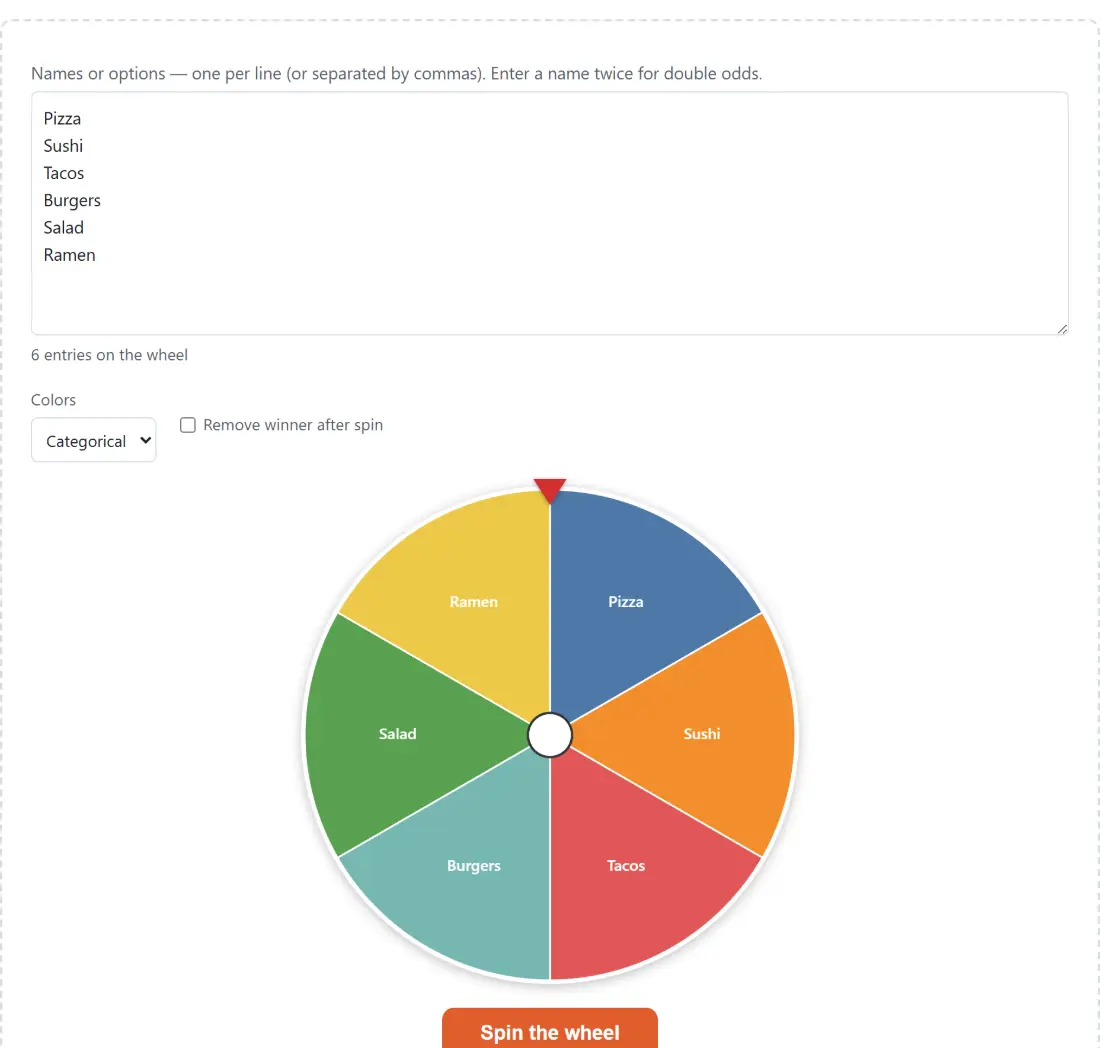
Screenshot of the Wheel of Names tool with a spinning wheel built from a list of entries typed one per line - six food options here - with a colour scheme choice and a note that repeating a name gives it double odds
Wheel of Names mid-process: a spinning wheel built from a list of entries typed one per line - six food options here - with a colour scheme choice and a note that repeating a name gives it double odds.
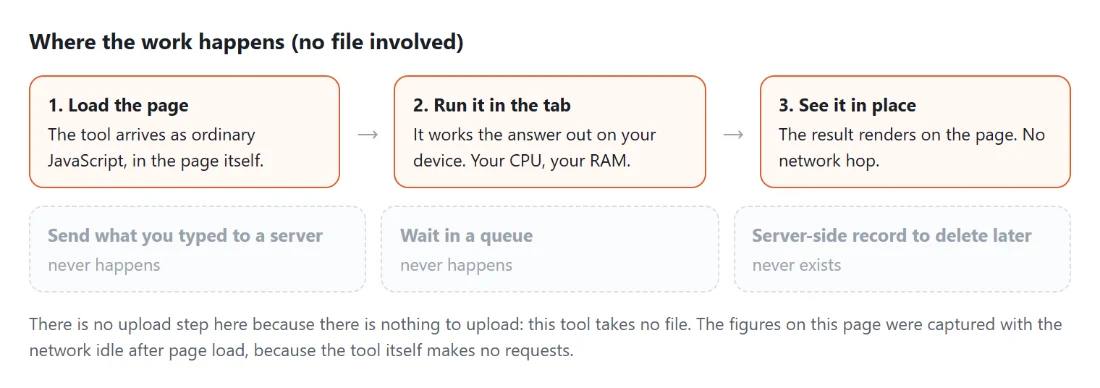
Diagram: where the work happens on a SysFenix page that has no file input at all: the tool arrives as ordinary JavaScript inside the page, works the answer out on your own device and renders it in place, so the upload, queue and server-side record a typical online tool needs never happen
Where the work happens on a SysFenix page that has no file input at all: the tool arrives as ordinary JavaScript inside the page, works the answer out on your own device and renders it in place, so the upload, queue and server-side record a typical online tool needs never happen.

Frequently asked questions

Is the spin actually random, or does the animation decide it?

The winner is chosen first and the animation is then calculated to land on it. A cryptographic random source picks the winning entry, and the rotation needed to bring that slice under the pointer is derived from the result. The spinning is presentation. That ordering is what makes the outcome genuinely uniform, because an animation whose stopping point decided the winner would inherit every bias in the physics.

How do I give one name better odds?

Enter it more than once. Every slice is exactly the same size, so two lines with the same name is two slices and twice the chance. That is deliberately the only weighting mechanism, because it needs no separate weight field, no rule about weights summing correctly, and it is instantly obvious from looking at the wheel how the odds stand.

What does removing the winner after a spin do to a duplicate?

It removes only the slice that was actually spun, identified by its position rather than its name. If a name appears twice and one of its slices wins, that one disappears and the other stays on the wheel with its remaining share of the odds. That is the correct behaviour for drawing several winners from a pool where somebody holds two tickets.

How many names can I put on it?

Up to 100, and anything beyond that is ignored with the count telling you so. A hundred is far past a classroom or a raffle, and also past the point where individual slices are readable. Once a slice's sweep drops below eight degrees, which happens somewhere around 45 entries, its printed label is hidden rather than drawn as unreadable overlapping text. The slice, its colour and its odds all remain exactly correct, and the winner's name is always announced in full after the spin.

Why does the pointer never land on a slice boundary?

Because the landing point is deliberately confined to the middle of the winning slice, with a margin kept clear at each edge. Landing exactly on a boundary looks ambiguous even when it is not, and an ambiguous looking result defeats the purpose of using a wheel to settle something. The margin means the pointer always sits clearly inside one colour.

Is a history of winners kept?

Yes, for the current session, listed under the wheel with a count and a control to clear it. It is not saved between visits and it is never transmitted. That covers the common case of drawing several winners in a row and wanting the list in front of you without writing them down.

Is anything sent to a server?

No. The names, the wheel graphic and the draw all exist only in your browser tab. There is no account, no saved wheel and no link to share a configured wheel with someone else, which is a real difference from some hosted alternatives and the reason nothing you type is stored anywhere.

Related tools