The 7x rule collapses at both ends of a dog’s life
Nearly everyone has heard that one dog year is worth seven human years. It is a tidy line, and it is wrong in two opposite directions at once. A dog on its first birthday is not the equivalent of a first-grader. It is sexually mature, close to its adult size in most breeds, and behaving like an adult. At the other end, the flat multiplier keeps adding seven a year long after a real dog’s aging curve has flattened out.
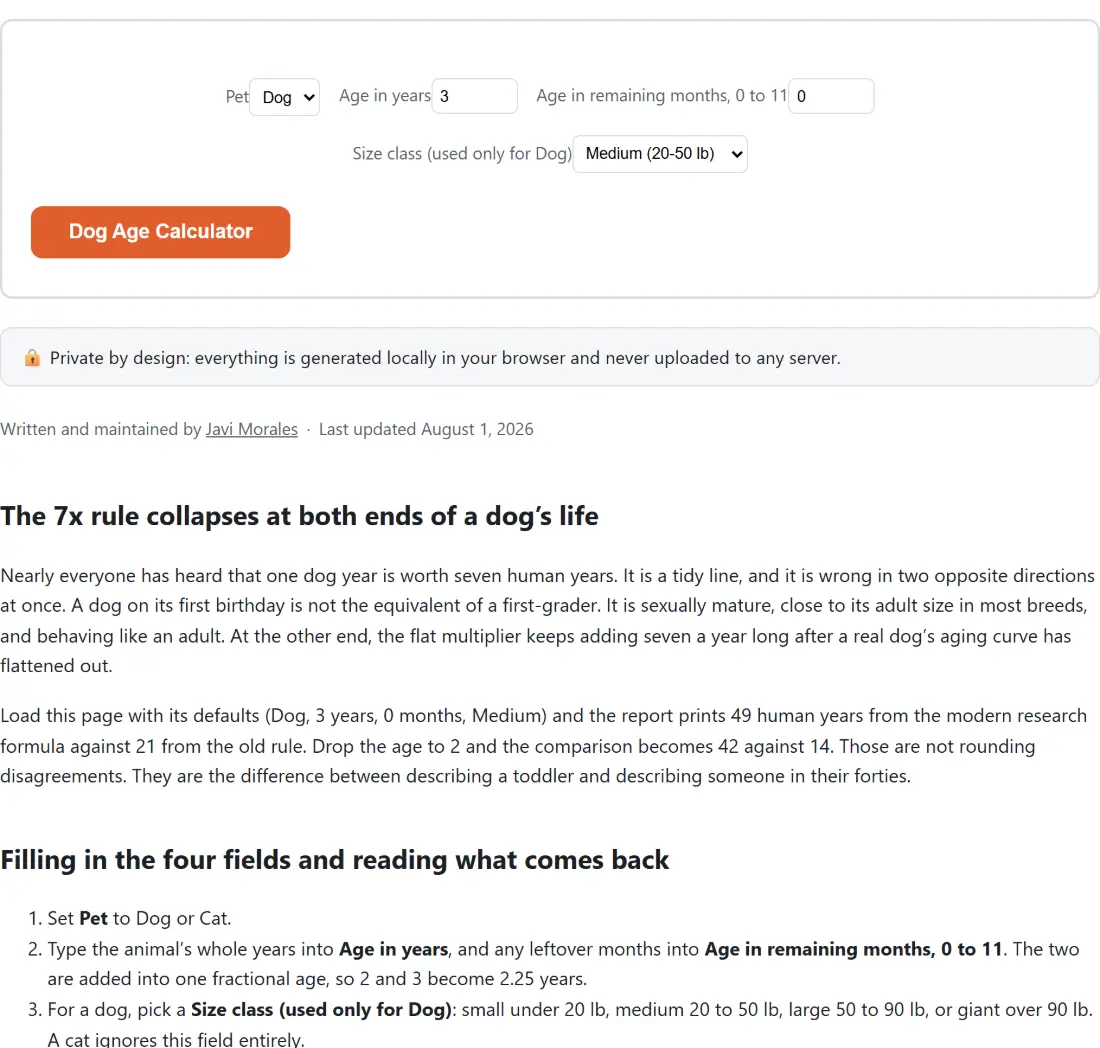
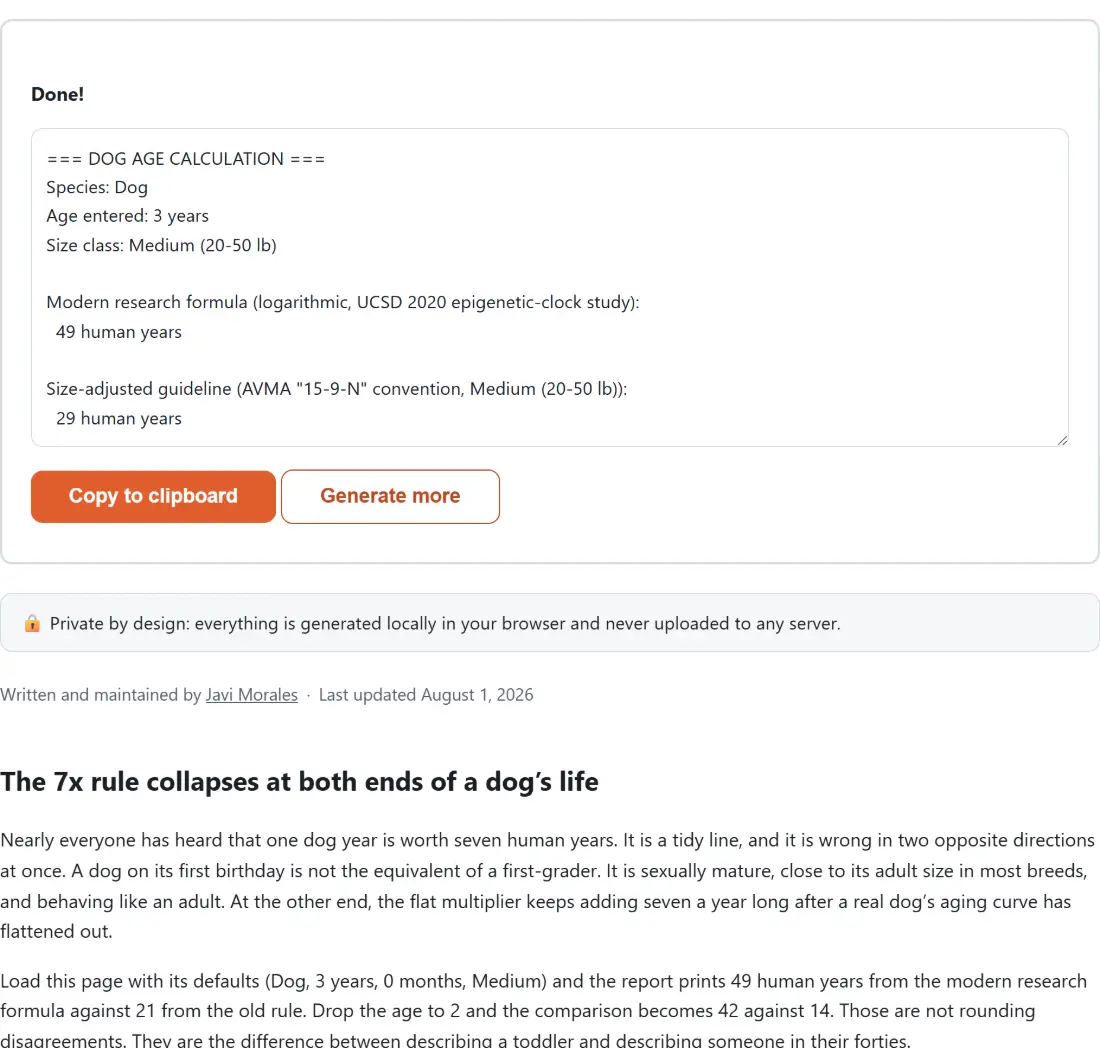
Load this page with its defaults (Dog, 3 years, 0 months, Medium) and the report prints 49 human years from the modern research formula against 21 from the old rule. Drop the age to 2 and the comparison becomes 42 against 14. Those are not rounding disagreements. They are the difference between describing a toddler and describing someone in their forties.
Filling in the four fields and reading what comes back
- Set Pet to Dog or Cat.
- Type the animal’s whole years into Age in years, and any leftover months into Age in remaining months, 0 to 11. The two are added into one fractional age, so 2 and 3 become 2.25 years.
- For a dog, pick a Size class (used only for Dog): small under 20 lb, medium 20 to 50 lb, large 50 to 90 lb, or giant over 90 lb. A cat ignores this field entirely.
- Press Dog Age Calculator. The plain-text report appears in the read-only box underneath, with Copy to clipboard and Generate more below it.
The options and the button are hidden while the report is showing. Click Generate more to bring the form back and try a different age, the same way the Age Calculator and the rest of the generator-style tools on the calculators hub behave.
Three numbers that will not agree, and that is the point
The report gives you three figures for every calculation: the logarithmic research formula, a guideline table for the species (size-adjusted for dogs), and what the 7x myth would have claimed. They are printed as three separate lines on purpose. Averaging them would invent a number that no study anywhere supports.
The two serious figures diverge most at the young end and at the old end. A one-year-old medium dog reads 31 from the logarithm and 15 from the table. A fifteen-year-old medium dog reads 74 from the logarithm and 89 from the table, with the ordering now reversed. That reversal is not a bug in either method; it is what happens when a molecular aging measurement and a population lifespan chart are asked the same question.
Where 16 x ln(age) + 31 came from
The headline figure is not folklore. It comes from a 2020 paper in the journal Cell Systems in which UC San Diego researchers compared DNA methylation, a chemical marker on the genome that shifts predictably with age, in Labrador Retrievers and in humans. Lining the two species’ curves up gave a logarithmic relationship rather than a linear one:
human age = 16 x ln(dog age) + 31Two caveats travel with it. The report itself flags the second one, printing a note whenever the age you entered falls below the study’s four-week floor; the first is not something the tool can detect, so it is stated here rather than in the output. The training data was overwhelmingly Labrador Retrievers, which is why the authors themselves called for other breeds to be tested. And the dogs in the study ranged from about four weeks old upward, so anything younger is extrapolation rather than measurement.
Size class moves the second figure and nothing else
Picking Giant instead of Small never changes the logarithmic number. It only changes the guideline table, and only after the second birthday. Every size class treats year one as 15 human years and year two as 24 in total. After that the annual increment splits: 4 human years for a small or toy breed, 5 for medium, 6 for large, 7 for giant. By the tenth dog year that quiet difference has become 56 for a small breed against 80 for a giant one, which matches the real pattern that big dogs have shorter lives. If you want to see that spread as a proportion rather than as raw years, the Percentage Calculator will do the arithmetic.
Puppies, seniors, and the edges where the maths misbehaves
Logarithms have no answer at zero, and this one dips below zero for any age under roughly 7.5 weeks. The calculator handles that with two independent safeguards, and it tells you when either one fires. The value fed to the logarithm is never allowed below four weeks, and the final figure is separately floored at zero, so an age of a few weeks returns 0 plus a note explaining that the raw formula would have produced a negative number. Enter something under four weeks and a second note appears saying the age sits below the study’s tested range.
At the top end the years field stops at 30, which comfortably covers any real dog or cat. Between those two extremes the numbers behave sensibly, but they are still population statistics rather than a reading taken from your animal. Genetics, diet, dental care and luck move a real lifespan around far more than a formula can express, which is why the report ends with an explicit note that it is not a veterinary assessment. For the human side of the household, the BMI Calculator is the closest equivalent on this site, and it carries the same kind of disclaimer for the same reason.
Cat mode swaps the table but keeps the dog formula on screen
Cats get their own convention rather than a rescaled dog number. The “15-9-4” rule agreed between AAHA, the American Association of Feline Practitioners and International Cat Care counts the first year as 15 human years, the second as 9 more, and every year after that as 4. A six-year-old cat therefore reads 40 on that line, and a fifteen-year-old reads 76.
One thing to know before you switch: the logarithmic line still prints in cat mode, and its label names only the UCSD epigenetic-clock study, not the fact that the study was run on dogs. It is computed for consistency rather than because it applies to cats, so in Cat mode the guideline figure is the one to read.