A tape measure, four numbers and one 1984 formula
The U.S. Navy circumference method was published by Hodgdon and Beckett at the Naval Health Research Center in 1984, and it was designed as a field test: something a unit could run with a flexible tape and nothing else. It estimates body fat percentage from circumferences and height rather than from anything that touches body composition directly. No scale, no calipers, no impedance electrodes, no scan.
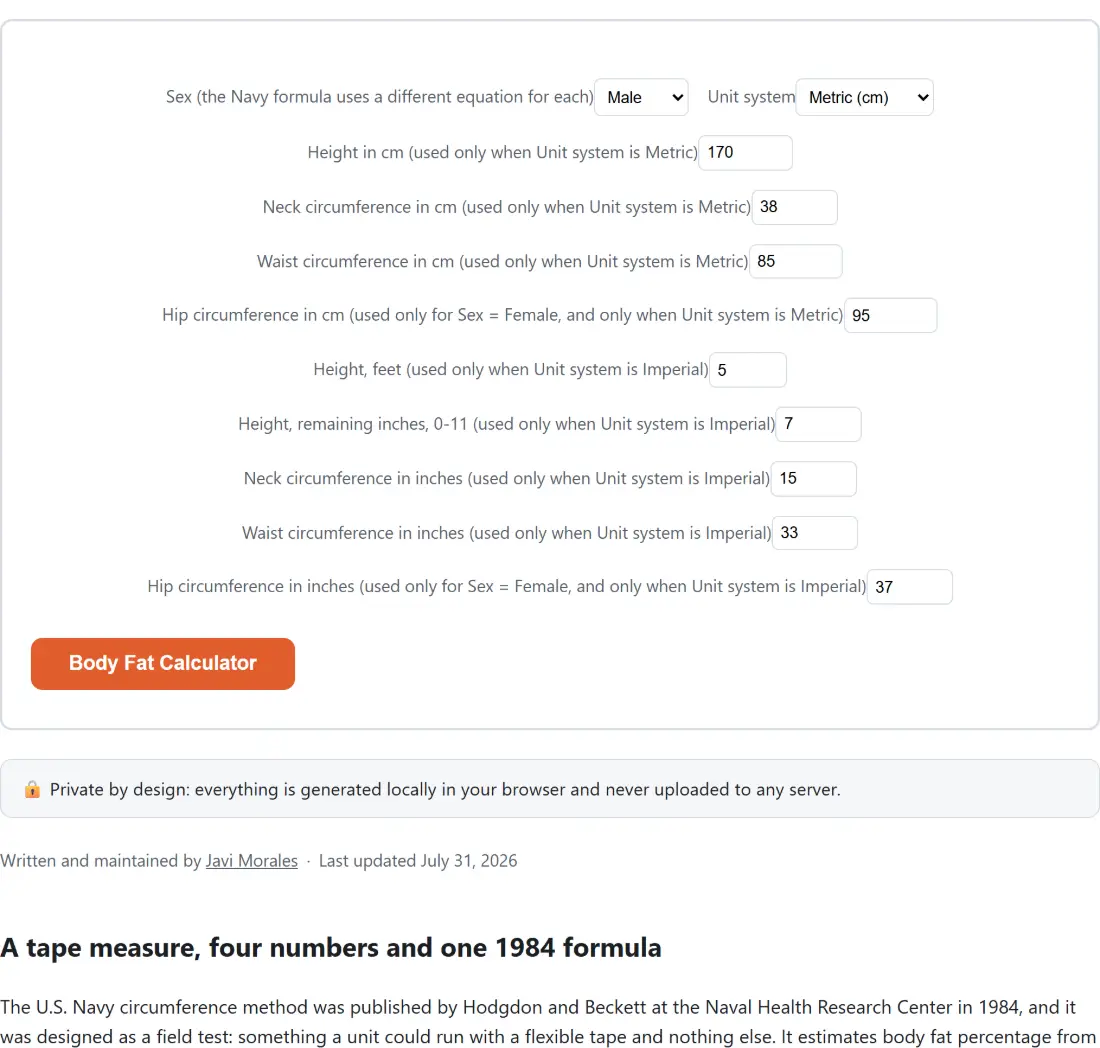
Men supply three numbers: neck, waist and height. Women supply four, adding hip. That is the whole input set, and it explains why there is no weight field on this page. The equations take base-10 logarithms of the circumference difference:
Men:   %BF = 86.010 x log10(waist - neck) - 70.041 x log10(height) + 36.76
Women: %BF = 163.205 x log10(waist + hip - neck) - 97.684 x log10(height) - 78.387
Two separate equations exist because the sexes distribute fat differently, and the women’s version gains enough accuracy from a hip measurement to be worth the extra minute with the tape.
Filling in the fields that actually get read
- Choose Male or Female under Sex (the Navy formula uses a different equation for each). The female equation is the one that reads a hip measurement.
- Choose Metric (cm) or Imperial (ft/in) under Unit system. Both sets of fields stay on screen, but only the set matching your choice is read, and hip is read only for Female.
- Type your height, neck and waist into that unit system’s fields, plus hip if you selected Female.
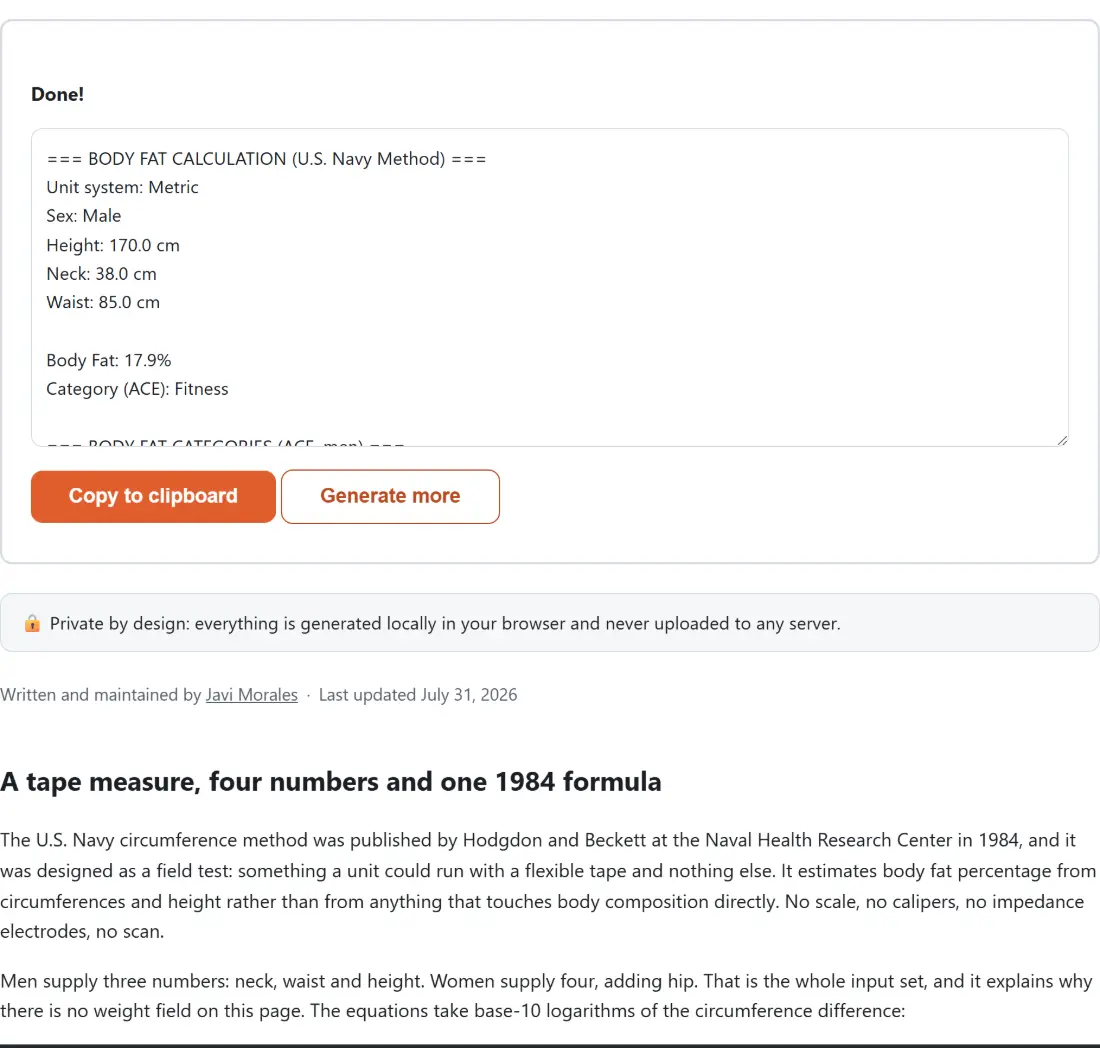
- Press the Body Fat Calculator button. The form is replaced by a text box holding the report.
- Use Copy to clipboard to keep it, or Generate more to bring the fields back and change a measurement.
The fields you leave alone are not a problem. Every one of them carries a starting value, and the inactive set is simply never consulted, so an untouched imperial height of five feet seven has no influence on a metric calculation.
Where the ACE bands put a number
The report classifies the result against the American Council on Exercise bands, and prints only the table for the sex you selected:
| Category | Men | Women |
|---|---|---|
| Essential Fat | below 6% | below 14% |
| Athletes | 6% to 13.9% | 14% to 20.9% |
| Fitness | 14% to 17.9% | 21% to 24.9% |
| Acceptable | 18% to 24.9% | 25% to 31.9% |
| Obese | 25% or above | 32% or above |
The bands sit at different heights for men and women because essential fat, the amount required for normal hormonal and reproductive function, is higher in women. A percentage that reads as athletic for one sex reads very differently for the other, which is why a single unlabelled number copied out of context is close to meaningless.
A margin wider than most single readings
Against laboratory methods such as DEXA or hydrostatic weighing, the tape method’s commonly cited spread is roughly three to four percentage points in either direction. That is not a small disclaimer to tuck away: it is wide enough that a fortnight of genuine progress can be smaller than the error bar on one measurement. It also cannot account for age, ethnicity, hydration or where the fat actually sits, and it has no way to tell a thick neck from a lean one.
The practical consequence is that the tape technique matters more than the arithmetic. In practice the thing that catches people out is the waist measurement drifting a centimetre or two between sessions, which is easily enough to invent progress that did not happen or hide progress that did. Measure after a normal exhale, keep the tape level and snug without compressing, and write down where you put it so the next session repeats it.
Numbers that pair with this one, and one that does not
This is an estimate from a published field formula, not a diagnosis and not a clinical measurement. Treat it as one input among several. The BMI Calculator works from height and weight alone and prints a WHO category, which is useful precisely because it fails in the opposite direction: it cannot separate muscle from fat, while the tape method has a guess at that split but never sees your weight. Running both takes under a minute and the disagreement between them is usually more informative than either alone.
If the goal behind the measurement is a change in body composition rather than a number for its own sake, the Calorie Calculator estimates daily energy needs from age, sex, height, weight and activity level, and the Macro Calculator works out your daily calories from the same body metrics and turns them, plus a cut, maintain or bulk goal, into protein, carbohydrate and fat targets. For the strength side of the same picture, the One Rep Max Calculator estimates a one-rep max from a weight and rep count, which is a far better progress signal than a tape during a maintenance phase. If you have any question about your body composition or your health, ask a doctor or another qualified healthcare professional rather than a web page.