A cup measures volume, a gram measures weight, and only the ingredient bridges them
This is the whole reason the tool exists. A cup is a fixed amount of space, a gram is a fixed amount of matter, and nothing converts one into the other without knowing what you are filling the cup with. A general-purpose converter cannot help here: Unit Converter will happily take you from cups to milliliters or from grams to ounces, but its volume list runs from milliliters through fluid ounces to gallons and each conversion stays inside its own category, so cups to grams is a question it is not built to answer. It also has no tablespoon or teaspoon at all, which is why those ratios are defined here instead.
Recipes are where this bites hardest, because a US recipe measures by volume and a European one measures by weight, and the same cup of two different powders can differ by a factor of four.
The density table behind the ingredient menu
Ten ingredients are covered, each stored as grams per US cup and each one a widely published baking-reference figure rather than a measured constant.
| Ingredient | Grams per US cup |
|---|---|
| All-purpose flour | 120 |
| Granulated sugar | 200 |
| Brown sugar (packed) | 213 |
| Powdered sugar (confectioners’) | 113 |
| Butter | 227 |
| Water / milk | 237 |
| Honey | 340 |
| Cocoa powder (unsweetened) | 85 |
| Rice (uncooked, white) | 185 |
| Vegetable oil | 218 |
Honey at 340 and cocoa powder at 85 are the extremes, and they make the point better than any explanation: the same cup, four times the weight. Butter is the one entry with a quirk worth knowing about. US butter comes in sticks of half a cup, printed as 113 g, and two sticks make 226 rather than the 227 this table uses. That single gram of disagreement is inherited from the published references themselves, and rounding it away would invent a precision nobody actually has.
Everything else follows from the table. Ask for 2 cups of honey in grams and you get 680, which is simply 340 doubled. Ask for 3 tablespoons of butter and you get 42.563 g, because three sixteenths of a cup at 227 g works out at 42.5625 before the result is rounded to three decimals.
Running one conversion end to end
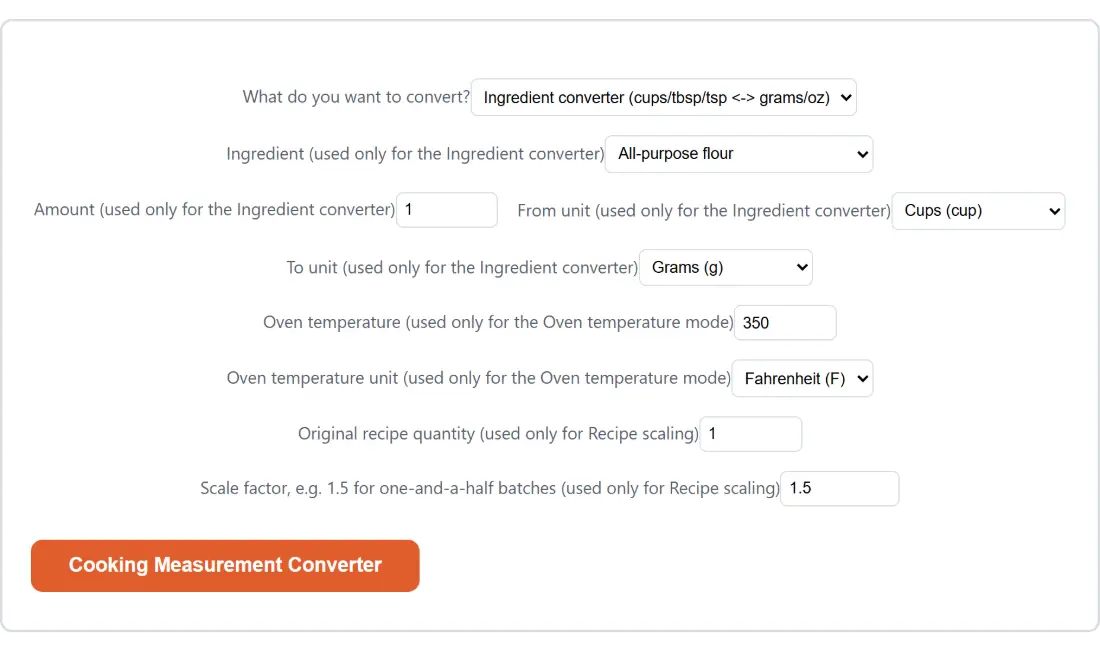
- Open What do you want to convert? and choose the ingredient converter, the oven temperature mode, or the recipe scaling calculator. Only the fields belonging to your choice are read, and every field label below is quoted here by its opening words, since on screen each one continues with a parenthetical naming the mode that reads it.
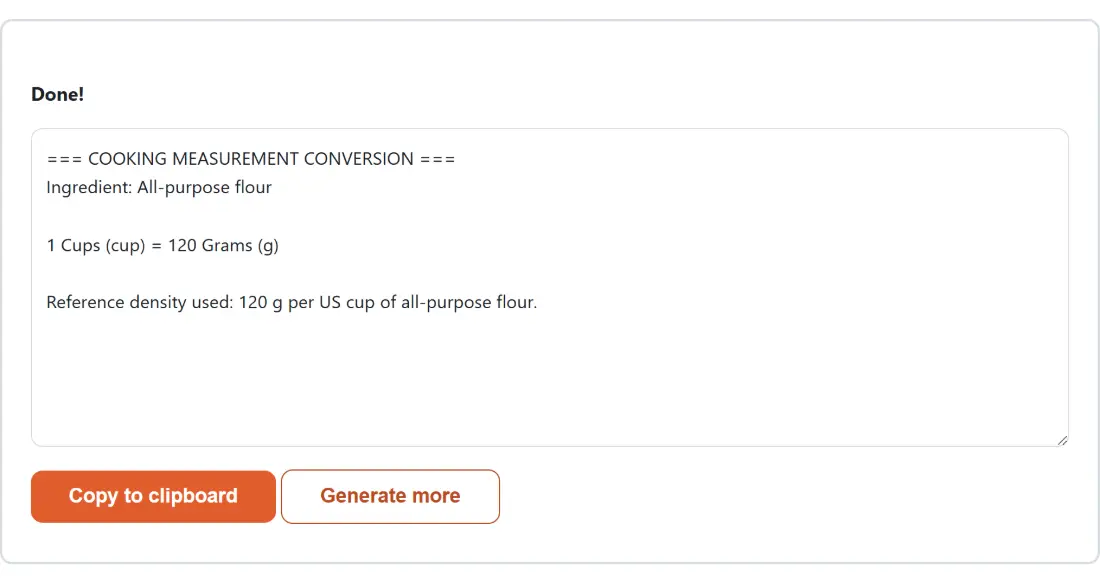
- For an ingredient conversion, set Ingredient, type the number into Amount, then set From unit and To unit. The defaults are one cup of all-purpose flour into grams, which answers 120.
- For an oven, put the number into Oven temperature and set Oven temperature unit to Fahrenheit or Celsius.
- For scaling, fill in Original recipe quantity and Scale factor, where 1.5 means one and a half batches.
- Click Cooking Measurement Converter. The button carries the tool’s own name, and the panel of options is replaced by the finished report.
- Use Copy to clipboard to take the text with you, or Generate more to bring the options back with your numbers still in them.
Gas mark is a lookup table, not a formula
Fahrenheit and Celsius convert with the exact affine formula, which is why the default of 350F comes back as 176.7C rather than a rounder number. Gas mark does not work like that. It is a set of published pairs, so gas mark 4 is the one everybody knows at 350F and 180C, even though 350F converts arithmetically to 176.7C. The report prints the arithmetic conversion, so 350F comes back as 176.7C, and names the mark on a separate line; the table’s own companion figure of 180C stays behind the scenes. The mark itself is found by taking whichever published Fahrenheit value sits closest to your temperature.
Enter 200C and you get 392F back, which lands nearer to gas mark 6 at 400F than to gas mark 5 at 375F, so gas mark 6 is what the report names. That is the honest answer for an old British recipe on a modern digital oven.
Scaling a batch into fractions your measuring cups actually have
Doubling is easy in your head. One and a half batches of two thirds of a cup is not. The scaling mode multiplies your quantity by the factor and then prints the answer twice, once as a decimal rounded to two places and once as the nearest kitchen fraction. Three cups at 1.5 comes back as 4.5 and as four and a half. Three quarters of a cup at the same factor comes back as 1.13 and as one and one eighth, and the fraction is the more useful of the two because your cups have an eighth mark.
If you are working with fractions rather than scaling them, Fraction Calculator shows the working for adding, subtracting, multiplying and dividing them outright.
Where these numbers stop being trustworthy
Density is not a constant. Humidity, brand, particle size and, above all, how the flour got into the cup all move it. Spoon flour in gently and level it off and you are near the 120 g this table uses; scoop the cup straight into the bag and pack it down and you can be a long way above that. Recipes that live or die on exact ratios (laminated pastry, bread hydration, macarons) deserve a scale rather than any conversion table, this one included.
The three modes also share one honest limitation: each run handles one number. There is no way to paste a whole ingredient list, because the options panel is built from fixed dropdowns and number fields with no repeatable rows. Scale each line separately, or work out the multiplier once and apply it by hand. For shopping rather than baking, Unit Price Calculator compares packet sizes on price per kilo, and the rest of the everyday math lives under calculators and in our guide to the free online calculators here.