Unit Price Calculator

Compare up to 12 products by true unit price. Mix grams, kilos, ounces, pounds, millilitres, litres, fluid ounces, gallons and counts. Free and private.

🌐 Español

1
2

Enter a price and quantity for at least two options to compare their unit prices.

🔒 Private by design: everything runs locally in your browser and never uploaded to any server.

The bigger pack is not always cheaper

Shelf pricing is designed to be hard to compare. The same product appears in three sizes, priced in a way that makes the large one feel obviously better value, and often it is not. A multi buy offer on the small size can beat the family pack. A promotion on the medium can beat both.

Most countries now require a unit price on the shelf label, which helps enormously, and it is frequently printed small, sometimes in different units between neighbouring products, and occasionally missing. Online it is worse, since a listing quotes a total price and a pack size and leaves the arithmetic to you.

This page does the arithmetic for as many options as you care to enter, converts everything into one comparable figure, and marks the winner.

Comparing products

  1. Enter a Price ($) and a Quantity for the first option, and choose its Unit.
  2. Do the same for the second. Results appear once two rows are complete.
  3. Add more rows if the product comes in more sizes, up to twelve.
  4. Read the best value marker, the price per kilogram, litre or item, and the per 100 figure.
  5. Check the percentage next to each other option to see how much more it costs.

Naming an option is optional. Leave the name blank and it is referred to by its position.

Why weight and volume are kept apart

The tool converts everything to a canonical unit within its dimension. Every mass becomes a price per kilogram, every volume a price per litre, and every count a price per item.

What it will not do is compare across those groups, and that restraint is the important part. Converting a price per litre into a price per kilogram requires the density of the specific product, which differs between olive oil and honey and washing liquid. A tool that guessed would be confidently wrong, so instead the groups are ranked separately and the mixture is pointed out.

In practice this comes up more than you would expect, because manufacturers do switch between selling a product by weight and by volume across pack sizes, and that is exactly the situation where a comparison needs to be refused rather than fudged.

The per 100 figure and why it is there

Alongside the price per kilogram or per litre, each option shows a price per 100 grams or per 100 millilitres. It is exactly a tenth of the larger figure, so it adds no information in a mathematical sense.

It earns its place because that is the unit shelf labels actually use in a great many shops. Having the same number in the same form as the label means you can check the tool against the shelf in a second, and it means you can compare a product you are holding against one you looked up, without converting between two conventions in your head at the till.

Percentages rather than differences

Every option other than the cheapest in its group shows how much more it costs per unit as a percentage.

A raw difference is nearly useless for deciding anything. Thirty cents per kilogram sounds small, and on a product you buy weekly in bulk it is not. Twelve percent more expensive is immediately interpretable regardless of the absolute prices involved, and it is the form in which the decision actually gets made.

Ties are handled properly too. Two options that work out to the same unit price through different conversion paths can differ in the final decimal places purely from floating point arithmetic, so a tolerance is applied and genuine ties are reported as ties rather than crowning an arbitrary winner by a fraction of a cent.

For the unit conversions on their own, Unit Converter covers the same factors across more categories. For an ingredient specific volume to weight conversion, which is the case this tool deliberately refuses to guess at, Cooking Converter handles it per ingredient.

At the till rather than the shelf, Tip Calculator splits a bill, and Percentage Calculator handles any other proportion question. Over a month, Budget Planner is where the savings show up. The rest are on the calculators hub.
See it in action

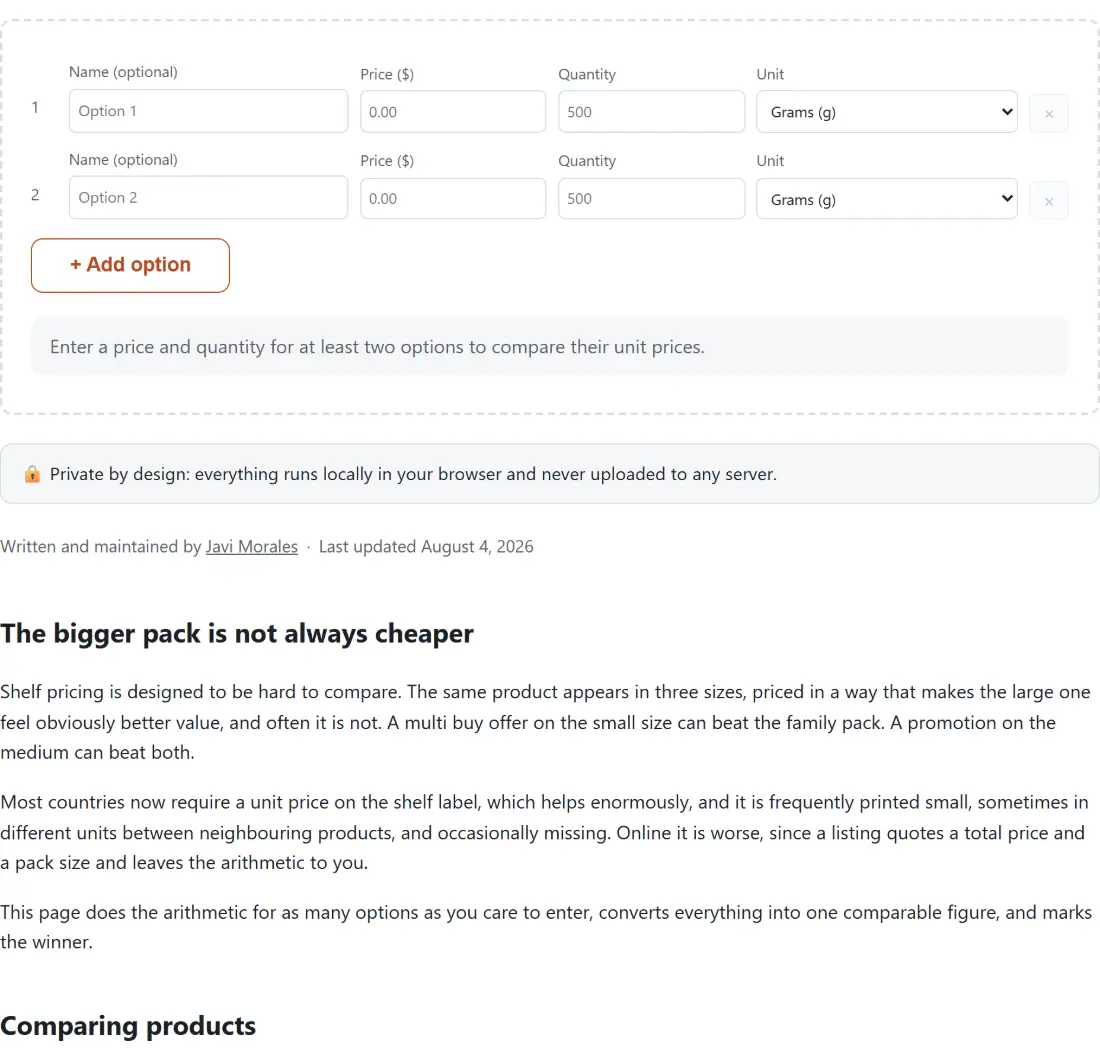
Screenshot of the Unit Price Calculator tool with rows of competing products, each with an optional name, a price and a quantity in grams, kilograms, ounces, pounds, millilitres, litres, US fluid ounces or gallons, compared on price per unit rather than on pack price
Unit Price Calculator mid-process: rows of competing products, each with an optional name, a price and a quantity in grams, kilograms, ounces, pounds, millilitres, litres, US fluid ounces or gallons, compared on price per unit rather than on pack price.
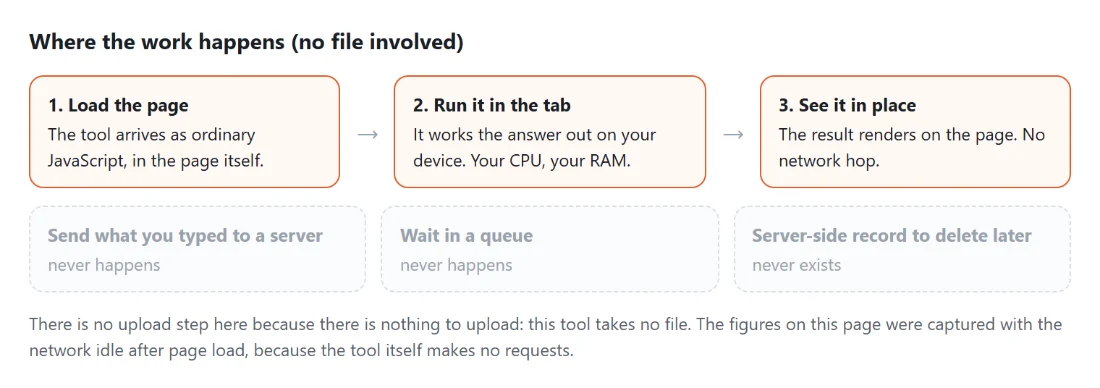
Diagram: where the work happens on a SysFenix page that has no file input at all: the tool arrives as ordinary JavaScript inside the page, works the answer out on your own device and renders it in place, so the upload, queue and server-side record a typical online tool needs never happen
Where the work happens on a SysFenix page that has no file input at all: the tool arrives as ordinary JavaScript inside the page, works the answer out on your own device and renders it in place, so the upload, queue and server-side record a typical online tool needs never happen.

Frequently asked questions

Can I mix units across the options I am comparing?

Yes, within a dimension. A 500 g pack, a 1.5 lb bag and a 2 kg box are all converted to a price per kilogram and ranked together, and the same happens for volumes in millilitres, litres, fluid ounces and gallons. Counts are handled as a price per item. The conversions come from the same exact factor tables the site's unit converter uses rather than a second set.

What happens if some options are by weight and others by volume?

They are compared within their own group and not against each other, and the page says so. A price per kilogram and a price per litre are not comparable without knowing the density of the product, which is information the tool does not have and would be wrong to guess at. Each group gets its own best value marker so the results are still useful.

What does the per 100 figure next to each price mean?

It is the supermarket shelf convention. Alongside the price per kilogram or per litre you get the price per 100 grams or per 100 millilitres, which is exactly a tenth of the larger figure, because that is how unit prices are printed on shelf labels in much of the world. Having both means you can check the tool against the label without doing the arithmetic yourself. Counts have no meaningful sub unit, so they do not get one.

How is the difference between options expressed?

Each option that is not the cheapest shows how many percent more it costs per unit than the best in its group. That framing is more useful than the raw difference, because a gap of fifty pence means nothing until you know whether it is on a two pound item or a twenty pound one. The percentage tells you directly how much you are paying for the convenience.

Is a free item handled sensibly?

Yes. A price of zero is treated as valid and wins, since something genuinely free is the best value. What is refused is a quantity of zero or below, because dividing by it is meaningless, and a negative price. Those rows are flagged for you to fix rather than silently dropped. A row where either field is still blank is treated as unfinished and ignored entirely, so the results do not flicker with errors while you type.

How many options can I compare?

Between two and twelve. Two is the minimum for a comparison to mean anything, and results only appear once at least two rows are complete. Twelve is the ceiling, which is comfortably more than the number of pack sizes any real shelf offers for one product.

Which currency does it use?

Whichever one you are shopping in. A dollar sign is used as a generic marker in the display, but nothing about the arithmetic depends on the currency, since every result is a ratio between a price and a quantity you entered. Just keep every option in the same currency within a single comparison.

Related tools