Shoe Size Converter

Convert between US, UK, EU and centimetre shoe sizes for men, women and children, with the full chart and the matching row highlighted as you type.

🌐 Español

Category

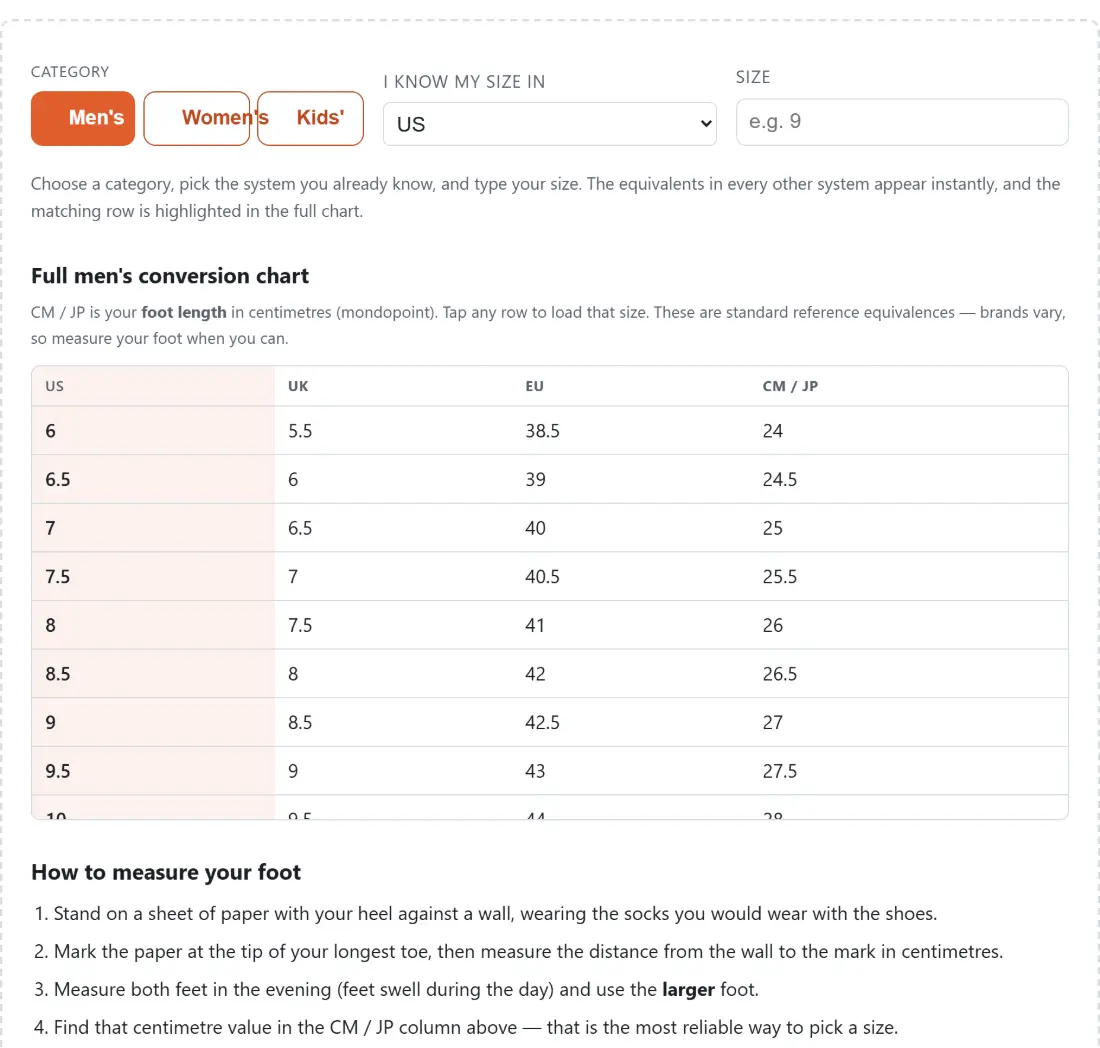
Choose a category, pick the system you already know, and type your size. The equivalents in every other system appear instantly, and the matching row is highlighted in the full chart.

Full men's conversion chart

CM / JP is your foot length in centimetres (mondopoint). Tap any row to load that size. These are standard reference equivalences — brands vary, so measure your foot when you can.

USUKEUCM / JP
65.538.524
6.563924.5
76.54025
7.5740.525.5
87.54126
8.584226.5
98.542.527
9.594327.5
109.54428
10.51044.528.5
1110.54529
11.51145.529.5
1211.54630
12.51246.530.5
1312.547.531
1413.548.532
1514.549.533

How to measure your foot

  1. Stand on a sheet of paper with your heel against a wall, wearing the socks you would wear with the shoes.
  2. Mark the paper at the tip of your longest toe, then measure the distance from the wall to the mark in centimetres.
  3. Measure both feet in the evening (feet swell during the day) and use the larger foot.
  4. Find that centimetre value in the CM / JP column above — that is the most reliable way to pick a size.

Every lookup runs in your browser from a built-in chart — nothing you type is sent to a server. Shoe sizing is not standardised: charts can differ by up to about half a size and brands (Nike, Adidas, Clarks and others) vary, so treat this as a starting point, not a guarantee of fit.

🔒 Private by design: everything runs locally in your browser and never uploaded to any server.

Two incompatible systems and a measurement

Shoe sizing is three different ideas wearing one label.

The US and UK scales descend from the barleycorn, an old English unit of a third of an inch, with each full size adding one barleycorn to the last. The EU scale uses the Paris point, two thirds of a centimetre per size. Those two increments do not divide into each other, so no exact conversion between them exists, and every chart in the world resolves the mismatch by rounding somewhere slightly different.

The third idea is mondopoint, which is simply the length of the foot in centimetres. It is the only one of the four columns that measures anything physical. Japanese sizing uses it directly, and it is the column worth trusting.

Because there is no correct formula, the tables here are the curated values published on international conversion charts, cross-checked against the two underlying systems. They are deliberately not tidied into a clean equation, since a clean equation would stop matching what shops actually print on the box.

Converting a size you already know

  1. Choose a Category. The three buttons are men’s, women’s and kids’, and they are separate scales rather than offsets of one another.
  2. Set the system you already know using the I know my size in dropdown.
  3. Type your number into the Size box. Letters and a comma decimal are tolerated, so a European 42,5 or a kids’ 1Y both work.
  4. Read the equivalents, which appear immediately for every other system.
  5. Look at the full chart underneath. Your matching row is highlighted, and the column you entered is highlighted too.
  6. Click any row in the chart to load that size into the box.
  7. If your value is not on the chart you get a message saying so rather than a nearest guess dressed up as an answer.

Half sizes and values between rows snap to the nearest row. The tolerance is tighter on the US, UK and centimetre columns, where rows sit about half a size apart, and wider on the EU column, where the gaps between published sizes are larger and uneven.

Men’s, women’s and kids’ are three different scales

This is the mistake that costs people a return. The three categories are not the same numbers with an offset, and switching category without re-reading your size gives a shoe that does not fit.

For the same foot length, a women’s US number runs about one and a half sizes above the men’s. Read across the centimetre columns and the relationship is visible: a foot of 25 centimetres appears at men’s US 7 and at women’s US 8.5. The UK relationship differs again, sitting half a size below the US in the men’s chart and two sizes below in the women’s.

Children’s sizing is not an offset of anything. It runs through a toddler range and then restarts at a youth range, so the numbers go up, reset, and climb again. The chart shows the C and Y markers on the US column for exactly that reason, and it covers the span where those labels apply. Beyond the top of it, children are into adult sizes.

Measure, then read across

The widget carries a short foot-measuring guide below the chart, and it is worth following once rather than converting numbers forever.

The reason is that every national size you know is already a conversion of a measurement somebody else took, possibly from a different last, possibly rounded twice. Your foot length in centimetres is not. Once you have it, the centimetre column is a direct lookup into the chart with no conversion error, and it is also the number to give a manufacturer’s own size guide when brands disagree, which they routinely do.

Two practical details matter more than they sound. Measure in the evening, because feet swell over a day and a shoe that fits at nine in the morning can be tight by six. And measure both feet, because most people have one longer than the other, and the shoe has to fit the larger one.

Treat the answer as a starting point

Nothing here is a guarantee of fit and the tool says so. Beyond the chart disagreement, individual brands run their own way, and running shoes, boots and dress shoes from the same maker often differ from each other. Width is not represented at all in any of these systems.

Everything runs from a built-in table inside your browser, so nothing you type is transmitted anywhere.

For other conversions between systems that never quite line up, Unit Converter handles length, weight, temperature, volume, area and speed, and Cooking Converter does the cups and grams problem. If you need to check a measurement without a tape to hand, Online Ruler is calibrated on screen. The rest is on the calculators hub.
See it in action

Screenshot of the Shoe Size Converter tool with a men's, women's or kids' category chosen first, then a size entered in whichever system the reader already knows - US, UK, EU or CM/JP - with the equivalents in every other system filled in alongside
Shoe Size Converter mid-process: a men's, women's or kids' category chosen first, then a size entered in whichever system the reader already knows - US, UK, EU or CM/JP - with the equivalents in every other system filled in alongside.
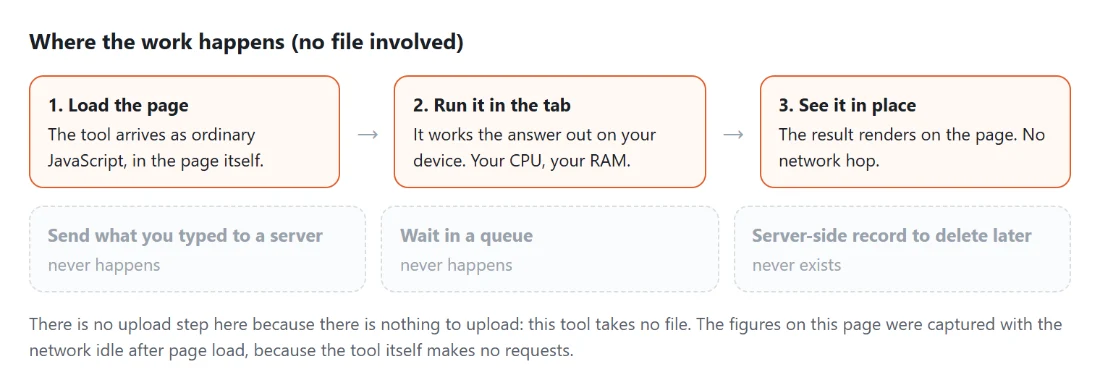
Diagram: where the work happens on a SysFenix page that has no file input at all: the tool arrives as ordinary JavaScript inside the page, works the answer out on your own device and renders it in place, so the upload, queue and server-side record a typical online tool needs never happen
Where the work happens on a SysFenix page that has no file input at all: the tool arrives as ordinary JavaScript inside the page, works the answer out on your own device and renders it in place, so the upload, queue and server-side record a typical online tool needs never happen.

Frequently asked questions

Why do different charts disagree about my size?

Because shoe sizing was never standardised. US and UK sizes come from the barleycorn, a third of an inch. EU sizes come from the Paris point, two thirds of a centimetre. Neither divides evenly into the other, so every published chart rounds the mismatch differently and charts can differ by around half a size. The tables here are curated chart values rather than a formula, precisely so they match what retailers actually print.

What is the CM column measuring?

The length of your foot, not the length of the shoe. It is the mondopoint scale, which is also what Japanese sizing uses, and it is the only column in the whole chart that refers to a physical measurement rather than a convention. That is why measuring your foot and reading across from the centimetre value is more reliable than converting between two national scales.

How much bigger is a women's US size than a men's?

About one and a half sizes for the same foot. Compare the centimetre columns and you can see it directly, since a 25 centimetre foot is a men's US 7 and a women's US 8.5. That offset is why buying a men's shoe in your women's number, or the reverse, lands you two shoes away from where you wanted to be.

Why do kids' US sizes restart at 1?

Because children's sizing runs through a toddler range labelled with a C and then starts again at a youth range labelled with a Y. The chart here covers from 10.5C up to 7Y, and above that children move into adult sizing. The US column shows those labels rather than bare numbers, so a 13.5C and a 1Y are never confused despite being adjacent rows.

What happens if I type a size that is not on the chart?

You get a message naming the value and the category rather than a wrong row. Values close to a real size snap to the nearest row, with a wider tolerance on the EU column because EU rows are spaced further apart. Anything beyond that tolerance is treated as out of range, which is usually a sign that you have the wrong category selected.

Can I type a size with letters or a comma in it?

Yes. A leading or trailing system name is ignored, so typing a size with US or EU attached works. Kids' markers such as a trailing C or Y are handled the same way. A comma is accepted as a decimal separator, so a European style 27,5 is read the same as 27.5.

Related tools