Counting syllables is guessing, and this tool admits it
There is no way to count English syllables from spelling with complete accuracy, because English spelling is not a reliable guide to English pronunciation. The only exact method is a pronunciation dictionary, and a dictionary large enough to be useful is a substantial download that would then still fail on proper nouns, brand names and anything invented after it was compiled.
So this tool uses a heuristic that reads the letters and applies the regular patterns of English: vowels group together, a final e is usually silent, and so on. On ordinary vocabulary it is right most of the time. On the awkward cases it is wrong in ways you can predict, which is far more useful than being wrong unpredictably, and the report says so at the bottom rather than presenting the number as a fact.
Getting a count
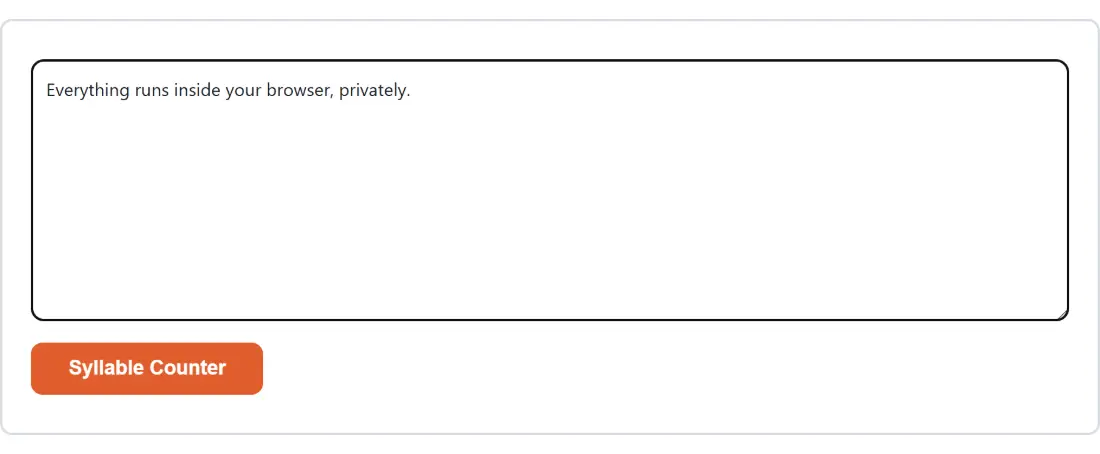
- Paste or type your text into the input box. Poetry, a paragraph, a single word, all work.
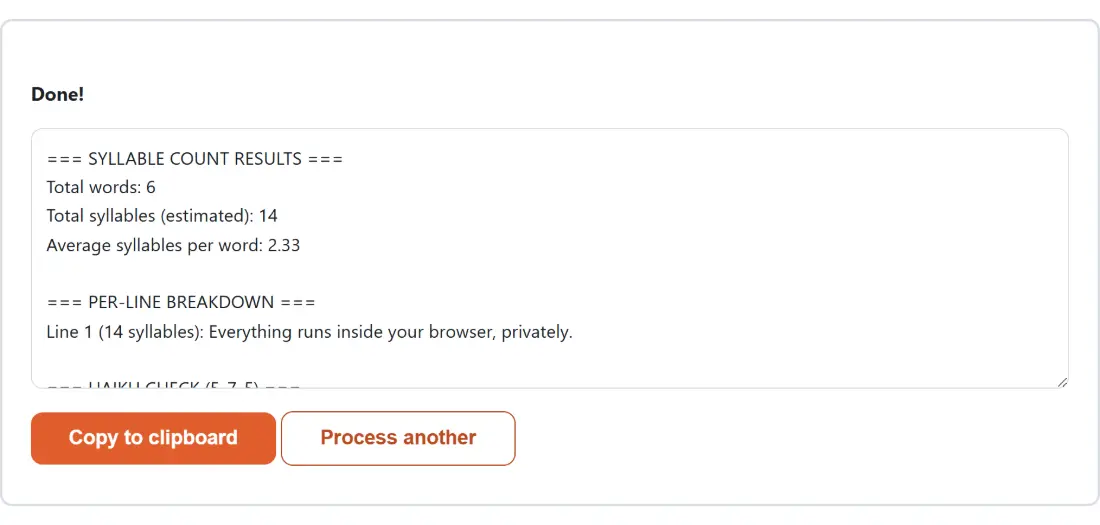
- Run it and read the summary block for the totals.
- Check the per line block if you are working on something with a fixed line length.
- Use the per word block to find the specific word behind a line total you disagree with.
The words it gets wrong, listed plainly
Two failure modes account for nearly everything.
The first is adjacent vowels that are actually pronounced apart. The heuristic treats a vowel run as one group, so poem becomes one syllable rather than two, and naive gets the same treatment. If your text is full of these, the total will read low.
The second is a written vowel that speakers skip. Every is counted as three because the letters suggest it, though most people say it as two. Business gets the same treatment for the same reason. Here the total reads high.
Then there is the genuinely contested set. Fire and hour are one syllable in some accents and two in others, and no rule can settle that from the spelling. Both are counted as one here, which is a choice rather than a truth.
The practical upshot for poetry is simple. Use the tool to get a line into range, then read it aloud, and trust your ear over the number when the two disagree.
The haiku check, and why it stays quiet
The 5-7-5 pattern is checked automatically whenever the text has exactly three non blank lines, and the check simply does not appear as a pass or fail on anything else. A two line poem or a five line one is a different form, not a failed haiku, and flagging it as wrong would be noise.
Blank lines are dropped before the count, which matters more than it sounds. A text area almost always ends with a newline, and treating that as a fourth empty line would knock every haiku out of the check for a reason that has nothing to do with the poem.
Reading past the counts
Syllables are one measure of writing density and they are most useful alongside others. Readability Checker uses syllable counts as one of its own inputs, which is the standard way reading grade formulas work, so the two tools tend to move together. Word Counter gives the plain totals plus reading time and shares this tool’s word splitting rule exactly.
For counting inside a document rather than pasted text, PDF Word Counter reads the file directly. If you are working on a poem and stuck on a word, Word Unscrambler finds candidates from a set of letters. The rest are on the text hub.