Three formulas measuring two things
Every readability formula in common use is built from the same two ingredients: how long your sentences are, and how long your words are. The differences between them are which ingredient they weight more heavily and what scale they express the answer on.
Flesch Reading Ease combines average sentence length and average syllables per word into a single number where higher means easier. Flesch-Kincaid Grade Level uses the same two inputs with different coefficients and outputs years of formal education. Gunning Fog swaps syllables per word for the proportion of words with three or more syllables, and also reports years of education.
All three are reported here, along with the counts they are computed from, so you can see why they came out where they did rather than just accepting a number.
Scoring a draft
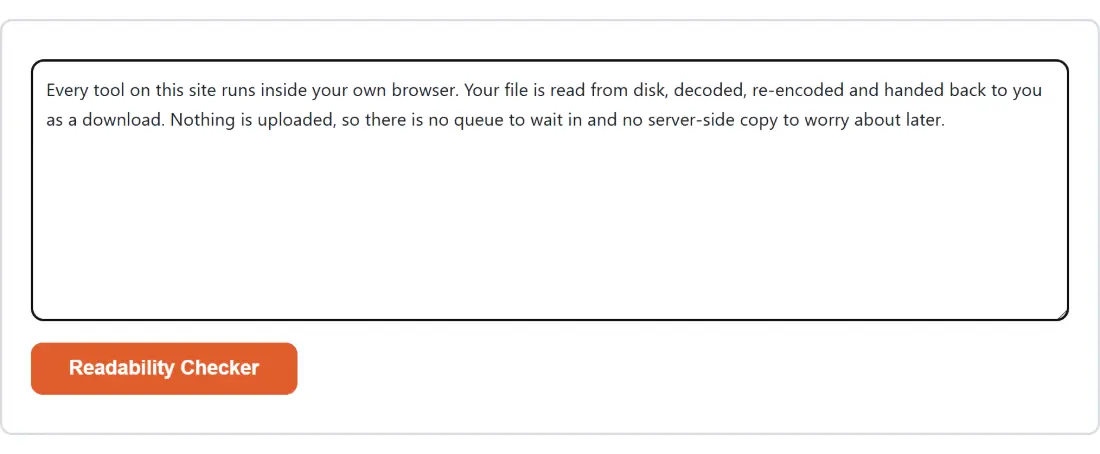
- Paste your text into the box. The action button stays disabled while it is empty.
- Click Readability Checker.
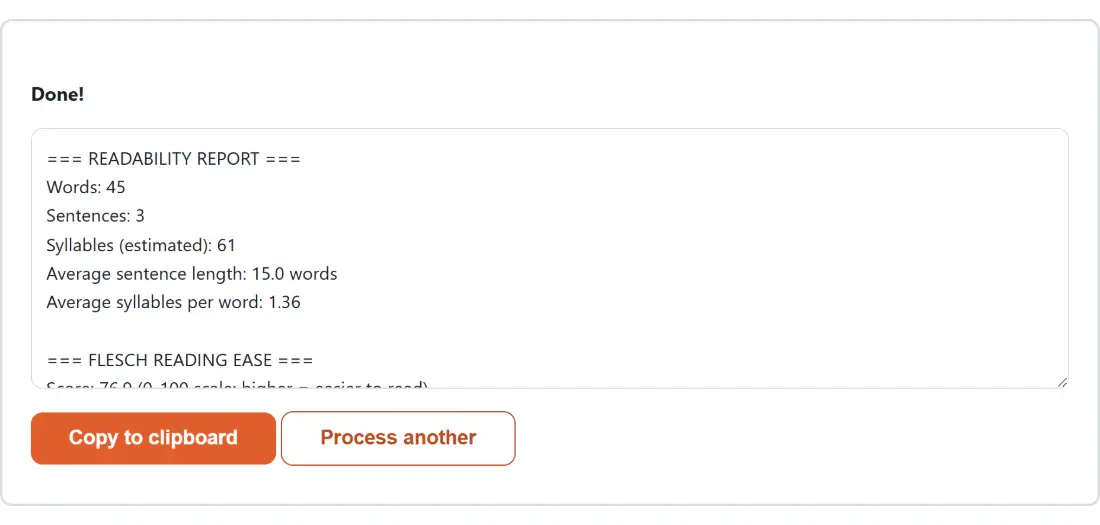
- Read the first block, which gives the word count, sentence count, estimated syllables, average sentence length and average syllables per word.
- Read the three score blocks underneath, each with its own plain-English interpretation.
- Click Copy to clipboard to take the whole report.
- Process another clears both boxes for the next draft.
Paste prose, not markup. Headings, bullet fragments and code will be counted as words and sentences and will pull every figure around.
The scales are not bounded
Flesch Reading Ease is universally described as a 0 to 100 scale, and that description is a convention rather than a constraint.
Take a sample of eleven one-syllable words split across two short sentences. That scores about 117, comfortably above the supposed ceiling, and the interpretation is exactly what you would expect: very easy. Push the other way with a single thirteen-word sentence of long abstract nouns and the score lands around minus 119, with the corresponding grade level above thirty.
Neither is a bug and neither is clamped. Reporting a raw negative Flesch-Kincaid grade tells you something true, that your text is simpler than the bottom of the scale was designed to describe, which a floor of zero would have hidden.
Syllables are estimated, and that is the weak link
There is no syllable dictionary here. Instead a small set of rules runs on each word: anything three letters or shorter is one syllable, a silent trailing e or a trailing ed is stripped, a leading y is dropped because it is a consonant sound in that position, and every remaining run of vowel letters counts once.
The vowel run detail matters. Counting each vowel separately, or capping runs at two, breaks common words: beautiful contains a three vowel cluster and correctly counts as three syllables only because the whole run is treated as one group.
The failures are honest and worth knowing. Rhythm has no written vowel nucleus at all, so it is counted as one syllable rather than two. Science is counted as one, because its vowel pair is treated as a single group when it is really two. Words like these drag the syllables per word average down and therefore make text look slightly easier than it is.
Every one of the three scores inherits that error. Two of them use syllables per word directly and the third uses the syllable count to decide which words are complex.
The fog index and its exceptions
Gunning Fog defines a complex word as one with three or more syllables, and then documents three exceptions to that rule.
Only one of the three is mechanically checkable without a dictionary, and it is implemented faithfully rather than approximated. Words that reach three syllables only because a common ending was added to a shorter root do not count. The implementation strips the ending and re-counts the root, so capturing is excluded because its root falls below three syllables, while interesting is not, because its root is still three.
The other two exceptions, proper nouns and familiar compound jargon, are not implemented and cannot be without a dictionary or a language model. A document full of long place names or product names will therefore score as harder than a human reader would judge it. The report prints the complex word count alongside the total, so you can see how much of the score rests on that judgement.
What to do with the number
Do not optimise to a target. A readability score is a symptom, and the useful move is to look at the two averages at the top of the report rather than the three scores at the bottom. A high average sentence length means splitting sentences. A high syllables per word average means replacing abstract nouns with concrete verbs.
For raw counts rather than scores, Word Counter gives words, characters, sentences and paragraphs. For poetry or a haiku check where syllables are the point rather than an input, Syllable Counter is the direct tool.
To check the same text for tone rather than difficulty, Sentiment Analyzer scores it against a word list. Keyword Density Checker covers the search angle, and Speech Time Calculator tells you how long the finished piece takes to read aloud. If your source is a PDF, extract the text with PDF to Text first. The rest is on the text tools hub.