Every length, not just the long shot
Most unscramblers assume you want the anagram, the single word that uses every letter you typed. That is the puzzle answer, and it is rarely the useful answer.
In a real word game the constraint is the board, not your rack. You have seven letters and a three letter gap next to a triple. What you need is every word you could make, at every length, ranked so you can find the one that fits.
So this searches from one letter up to however many you typed, and returns the lot. The sort order then decides which end of that list you look at first.
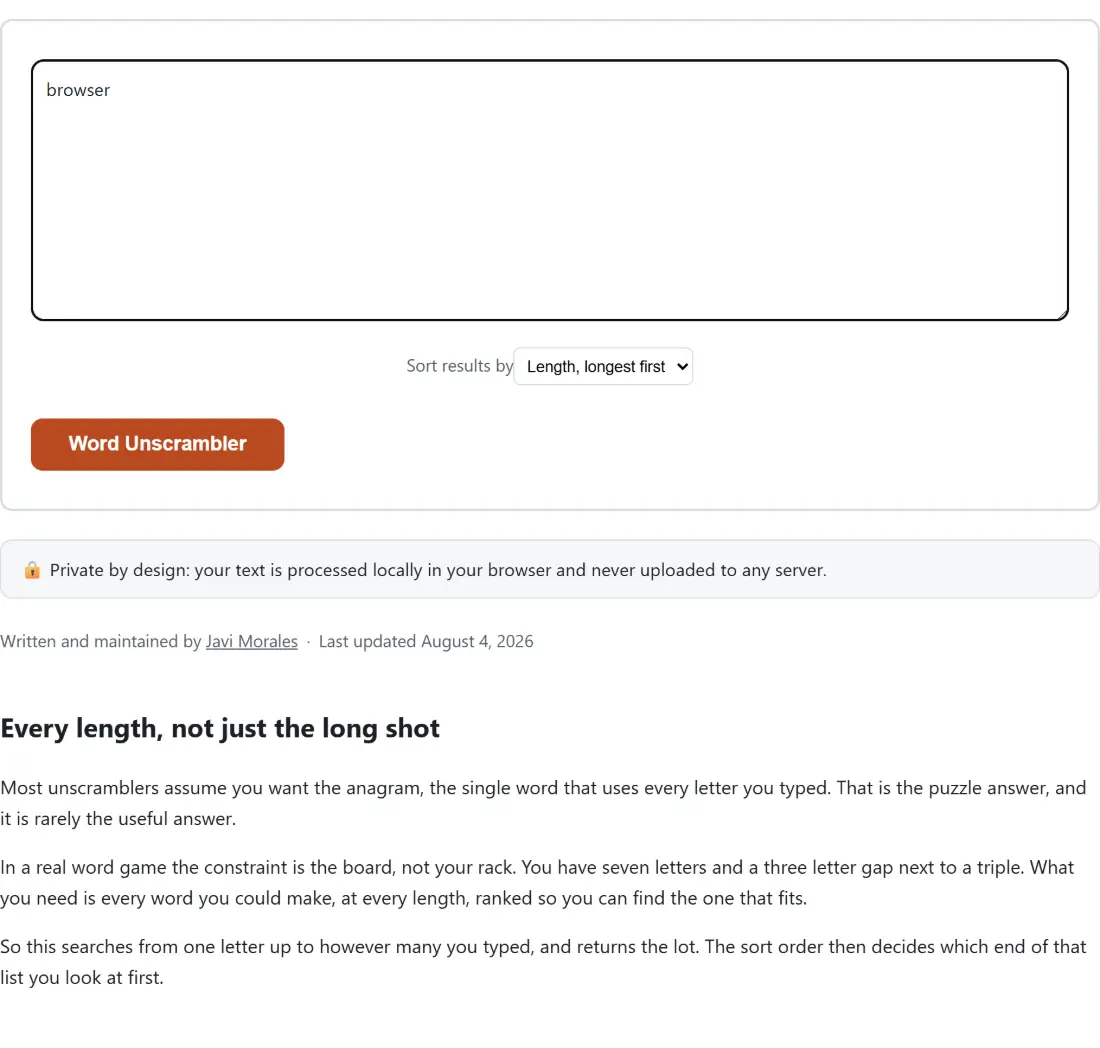
Unscrambling a set of letters
- Type your letters. Spaces, digits and punctuation are ignored, so a jumbled mess pastes fine.
- Add a question mark or an asterisk for each blank tile you hold.
- Choose a Sort results by order.
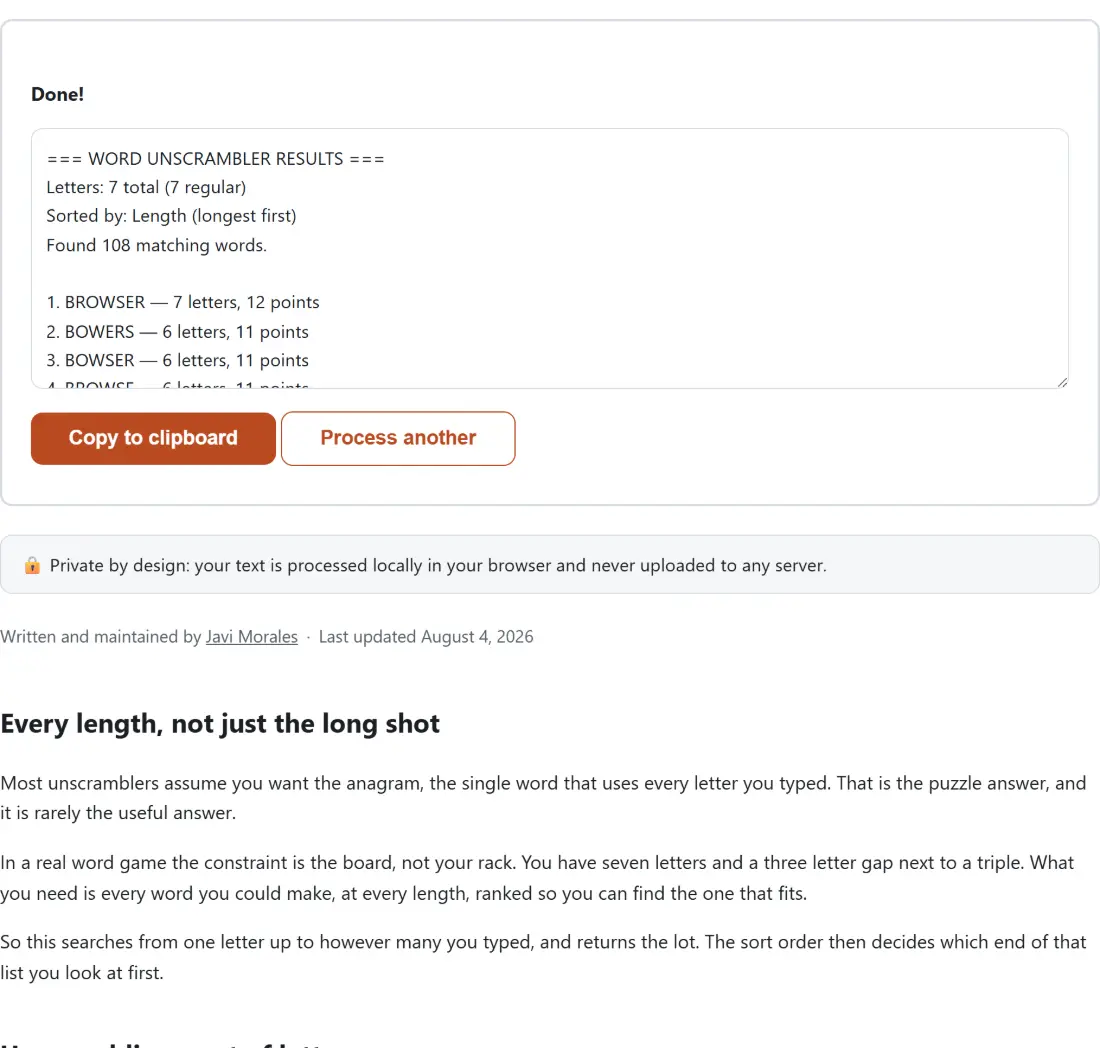
- Run it and read the list, each entry with its length and score.
Wildcards, and what they cost
A wildcard stands in for any single letter. Type two of them and any two letters in a candidate word can be covered.
The matching is done by comparing what a word requires against what you actually hold, letter type by letter type, and adding up the shortfall. If that total shortfall is no larger than the number of wildcards you have, the word is reachable.
The scoring then applies the real rule that makes blanks interesting. A letter covered by a wildcard scores nothing at all, exactly as a blank tile does in the game, whatever letter it stands in for. That is why the same word appears with a very different score depending on whether you hold the actual letters, and it is precisely the trade off a player is weighing when deciding whether to spend a blank.
The three sort orders solve three different problems
Sorting by length is the default and answers the show off question. The longest word you can build sits at the top.
Sorting by score answers the game question, and it very often disagrees with length. A short word using a high value letter beats a long word made entirely of common ones, and if you are keeping score that is the play. The disagreement between the two orderings is itself informative.
Sorting alphabetically answers the verification question. When you want to know whether one specific word is in the list, scanning an alphabetical list takes seconds and scanning a list ordered by length takes minutes.
There is a fourth question the tool cannot answer, which is whether a word will actually play. That depends on the board, the letters already on it and the squares you can reach, none of which this page knows anything about. What it gives you is the set of words your letters allow, and narrowing that set down to the one you can legally place is still your job.
About the dictionary
The word list is a general purpose open English dictionary, bundled with the site and loaded as its own chunk only when the tool runs, so simply visiting the page costs nothing.
It is not an official tournament word list, and the distinction matters for competitive play. Tournament lists are curated, licensed and differ between regions, and they include obscure entries a general list omits while excluding informal ones a general list contains. For a casual game the difference is irrelevant. For a competitive one, treat this as a suggestion engine and confirm against the list your game actually uses.
Related word tools
For counting rather than building, Word Counter gives totals and reading time, and Syllable Counter breaks words down for poetry. To change the case of a result before using it somewhere, Case Converter handles that.
To turn a set of words into study material, Flashcard Maker produces printable cards. To compare two lists of words, Diff Text lines them up. The rest are on the text hub.