Six fields, no Calculate button, and a table that redraws as you type
- Type what you are borrowing into Loan amount ($). That is the purchase price minus your down payment, not the price of the house.
- Enter the rate in Annual interest rate (%) as a percentage, so 6.5 rather than 0.065, and put the number of years in the Loan term (years, 1–50) field, which rounds what you type to a whole year and pulls anything outside that range back inside.
- Add an amount to Extra monthly payment ($) if you want to see an early payoff. Leave it empty and the comparison is simply not shown.
- Fill in Annual property tax ($) and Annual home insurance ($) if you want a full housing figure rather than a loan figure. Both are annual amounts, divided by twelve for you.
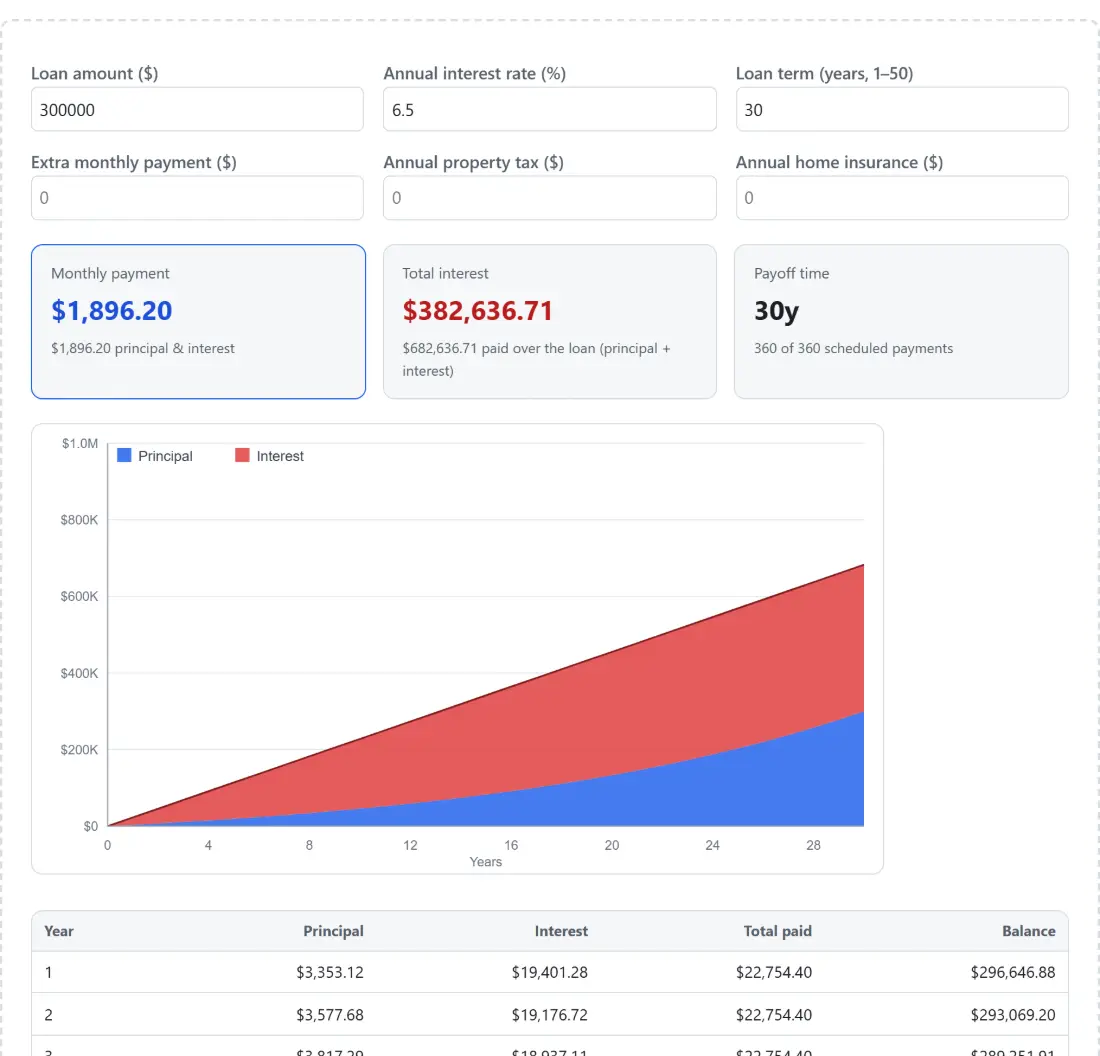
- Read the three summary tiles: Monthly payment, Total interest and Payoff time. Below them sit the chart and a table with Year, Principal, Interest, Total paid and Balance columns.
There is no button to press. Every field recomputes the schedule, the chart and the table on each keystroke, because the whole projection is a pure function that is cheap enough to run that often.
The default loan, and the $382,636.71 most people underestimate
The page opens with a worked example rather than empty boxes: 300,000 dollars at 6.5 percent over 30 years. The payment comes out of the standard fully amortizing formula, which in plain ASCII is:
M = P * i * (1 + i)^n / ((1 + i)^n - 1)P is the amount borrowed, i is the monthly rate (the annual rate divided by twelve and then by a hundred), and n is the number of monthly payments. For that loan it gives 1,896.20 a month.
The number that surprises people is the other one. Across 360 payments you hand over 682,636.71, of which 382,636.71 is interest. You repay more in interest than you borrowed in the first place. Change the rate to 7.5 percent and the payment moves to 2,097.64, but the interest total moves to 455,155.38, a jump of over seventy thousand dollars for one percentage point. Shorten the term instead and it goes the other way: fifteen years at the same 6.5 percent costs 2,613.32 a month, which is a much larger cheque, but the total interest falls to 170,398.28.
That is the real decision this page exists for. Not what the monthly payment is, but what a rate or a term is worth over the life of the loan.
Year 20 is where principal finally beats interest
Interest is charged on what you still owe, and at the start you owe nearly everything. In month one of the default loan, 1,625.00 of the 1,896.20 payment is interest and only 271.20 touches the balance. A year in, the table’s first row reads 3,353.12 of principal against 19,401.28 of interest, for 22,754.40 paid, and the balance has crawled down only to 296,646.88.
Halfway through the term it still looks lopsided. The year 15 row shows 8,309.84 of principal against 14,444.56 of interest, and the balance is 217,678.77, so after fifteen years of payments you have retired a little over a quarter of the loan. The crossover, where more of the year’s money goes to principal than to interest, does not arrive until year 20: 11,490.95 against 11,263.45. Month by month it happens at payment 233. By the final year the split has inverted completely, 21,977.51 of principal against 781.60 of interest.
The chart draws exactly this. The blue band is cumulative principal repaid and the red band above it is cumulative interest, stacked so their top edge is everything you have paid so far. Watching the red band grow fast and then flatten while the blue one accelerates is the clearest picture of amortization there is. It shares its geometry and currency formatting with the Compound Interest Calculator, which draws the same shape for money working in your favour rather than against it.
Integer cents, and the last payment that is not $1,896.20
Amortization schedules have a well-known bug: round each month to the nearest cent, run 360 of them, and the balance finishes a few cents away from zero. Here the whole schedule is kept in integer cents, so no floating-point residue can accumulate, and the final payment is treated as a special case. Its principal portion is set to whatever balance remains, and its payment is recomputed as interest plus that principal.
On the default loan that makes payment 360 come to 1,900.91, made up of 10.24 in interest and 1,890.67 in principal, and the balance lands on exactly zero. It is not a rounding fudge hidden from you; it is what a real fixed-term loan does, and it is why the year 30 row of the table reads 22,759.11 paid rather than the 22,754.40 every other year shows. Every row satisfies principal plus interest equals payment, and the interest column adds up to the headline total.
Where $200 a month actually goes
Type 200 into the extra payment field and the schedule stops early. Payoff falls from 360 payments to 277, reported as 23 years and 1 month, which is 6 years and 11 months ahead of schedule. Total interest drops from 382,636.71 to 279,186.52, a saving of 103,450.19 for an outlay of 200 a month. The monthly total becomes 2,096.20, and the loan’s last payment shrinks to 635.32 because there is so little left to clear.
The leverage comes from where the extra lands. It is added to principal, not to interest, so it permanently removes a piece of balance that would otherwise have been charged interest every month for decades. The saving figure the page shows is an honest comparison: the same loan is run twice internally, once with the extra and once without, and the difference between the two interest totals is what gets reported.
Whether that 200 is available every month is a budgeting question rather than a mortgage one, which is what the Budget Planner is for, and the Salary to Hourly Converter helps if you are working backwards from take-home pay.
Escrow rides on top, and PMI is not modelled at all
Property tax and insurance are collected with your payment by most lenders, but they are not part of repaying the loan, and mixing them into the amortization would quietly corrupt every interest figure on the page. So they are kept out of it. Enter 3,600 of annual tax and 1,200 of annual insurance on the default loan and you get 300 plus 100 of escrow added on top of the 1,896.20, for a monthly total of 2,296.20. The balance, the interest column and the payoff date do not move by a cent.
Three things are deliberately absent: private mortgage insurance, homeowner association dues, and closing costs. Each depends on details this page cannot see, and inventing them would make the estimate look more authoritative than it is. Add them yourself on top of whatever the page shows. If you need to work out a down payment as a percentage of the purchase price before you even get here, the Percentage Calculator does that in one step, and the rest of the money tools sit on the calculators hub alongside the online calculators guide.
Everything above is an estimate for comparing scenarios, produced by arithmetic that assumes one fixed rate for the whole term. It is not a quote, not an offer, and not advice.