White Noise Generator

Mix white, pink and brown noise with rain and ocean ambience on independent level sliders, with a sleep timer. Synthesised live, nothing is downloaded.

🌐 Español

White Noise0%
Pink Noise0%
Brown Noise60%
Rain0%
Ocean Waves0%

🔒 Private by design: everything runs locally in your browser and never uploaded to any server.

Five sounds, generated rather than streamed

Most noise sites stream an audio file. That means a download, a network dependency for as long as you are listening, and a loop that eventually becomes recognisable because it is a recording of finite length.

This page synthesises everything live in your browser. There are no audio files involved anywhere, so nothing is downloaded, nothing is streamed, and once the page has loaded the connection is irrelevant. It also means the five sounds can be mixed freely, since each is generated independently rather than being a fixed track.

Using the mixer

  1. Raise the level slider on whichever sounds you want. Anything at zero is silent.
  2. Press play.
  3. Adjust the levels while it runs to find a blend you like.
  4. Set a Sleep timer if you want it to stop on its own. The remaining time is displayed.
  5. Press stop at any point.

The three noise colours, and what they actually mean

The colour names describe how energy is spread across the frequency spectrum, and they are technical rather than poetic.

White noise has equal energy at every frequency. Because our hearing groups high frequencies into wider bands, that even distribution reads as bright and hissy, like static between radio stations. It masks other sounds very effectively and a lot of people find it tiring over hours.

Pink noise reduces energy as frequency rises, in a way that roughly matches how hearing itself is weighted. That is why it sounds balanced and natural rather than bright, and why it is the one most often recommended for sleep and long sessions.

Brown noise falls away faster still, leaving mostly low frequency content. It reads as a deep rumble, like heavy rain on a roof, distant traffic or a waterfall, and it is the most effective of the three at covering low frequency intrusions such as footsteps upstairs.

Rain and ocean are honest approximations

Neither is a recording, and neither pretends to be.

Rain is built by taking pink noise, which already has the broadband watery character, and applying a slow sparse amplitude envelope on top. The result is a gentle pattering variation rather than a constant hiss, which is what distinguishes rain from plain noise perceptually.

Ocean uses brown noise for its deep rumble and applies a much slower envelope, wandering over thousands of samples rather than hundreds, producing the swell and recede pattern of surf.

Both envelopes are bounded so neither ambience ever fully mutes or spikes, which keeps them usable as background rather than as something you notice. They are not going to be mistaken for a field recording, and they loop forever with no download, which for a sleep or focus sound is the trade most people want.

The loop is exactly seamless

Each sound is a 20 second buffer that repeats. Twenty seconds is long enough that the repetition period is not obvious for a background sound.

Repeating a buffer joins its last sample to its first, and if those two values differ noticeably the join is heard as a click on every single repeat. White noise has no such problem, since every sample is independent of its neighbours anyway. The filtered types do, because their filters carry state, so the end of the buffer has drifted somewhere unrelated to where it started.

The fix applied here blends each buffer’s tail toward its own first sample over a short window, arranged so that the final sample ends up exactly equal to the first. That is an exact equality rather than a reduction in the size of the jump, which is why there is genuinely no click rather than a quiet one.

For a timed work session rather than continuous background sound, Pomodoro Timer structures it and Online Timer covers a plain countdown. For a guided breathing pattern, Breathing Exercise runs one on screen.

For tones rather than noise, Binaural Beats Generator produces the two channel effect and Tone Generator covers single frequencies across the audible range. The rest are on the audio hub.
See it in action

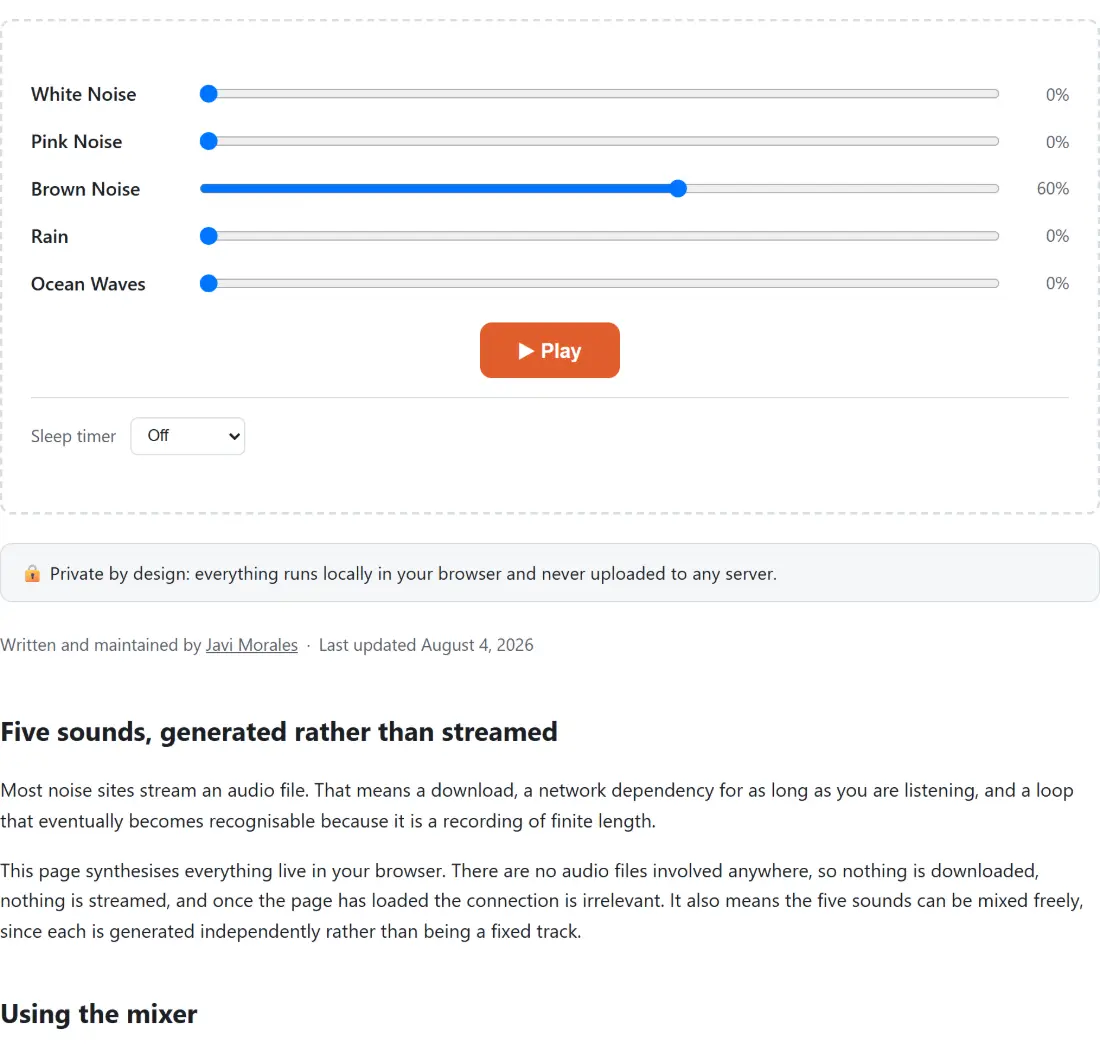
Screenshot of the White Noise Generator tool with five sound layers mixed independently - white, pink and brown noise, rain and ocean waves - with brown noise up at 60% here, plus a sleep timer offering 15 minutes through two hours
White Noise Generator mid-process: five sound layers mixed independently - white, pink and brown noise, rain and ocean waves - with brown noise up at 60% here, plus a sleep timer offering 15 minutes through two hours.
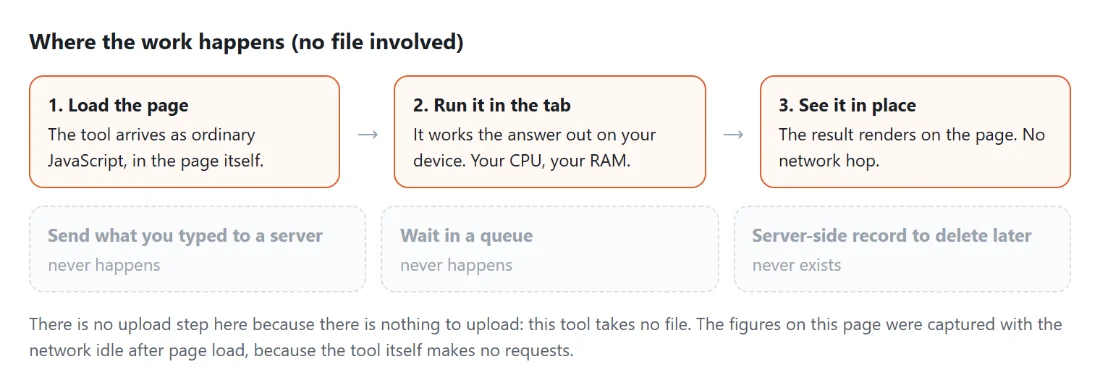
Diagram: where the work happens on a SysFenix page that has no file input at all: the tool arrives as ordinary JavaScript inside the page, works the answer out on your own device and renders it in place, so the upload, queue and server-side record a typical online tool needs never happen
Where the work happens on a SysFenix page that has no file input at all: the tool arrives as ordinary JavaScript inside the page, works the answer out on your own device and renders it in place, so the upload, queue and server-side record a typical online tool needs never happen.

Frequently asked questions

Are the rain and ocean sounds real recordings?

No, they are synthesised, and it is worth saying plainly. There are no audio files behind this page at all. Rain is pink noise with a slow sparse amplitude envelope over it, which gives the pattering texture, and ocean is brown noise with a much slower envelope that produces a swell and recede cadence. They are approximations of the real thing rather than field recordings, and they loop forever without a download.

What is the difference between white, pink and brown?

How the energy is distributed across frequency. White has equal energy at every frequency and sounds bright and hissy, like an untuned radio. Pink has less energy the higher you go, which matches how our hearing weights frequencies and is why it sounds more balanced and natural. Brown falls away faster still, leaving a deep rumble like distant traffic or a waterfall.

Can I play more than one at once?

Yes, and that is the main reason the interface is a mixer rather than a picker. Every one of the five has its own level slider, so rain over brown noise, or a little ocean under pink, are all one setting away. Any channel at zero is not playing, and each channel's contribution is independent of the others.

Does it loop, and can I hear the join?

It loops, and the join is inaudible by construction. Each sound is generated as a 20 second buffer that repeats. Because the filtered types carry state from one sample to the next, jumping straight back to the start could click, so the tail of each buffer is gradually blended toward its own first sample, with the very last sample ending up exactly equal to the first. That is an exact equality rather than an approximation, so there is no discontinuity to hear.

What does the sleep timer offer?

Off, or 15, 30 or 45 minutes, or 1, 1.5 or 2 hours. When one is running the page shows the remaining time counting down, and playback stops when it reaches zero. It exists because leaving audio running all night is the usual outcome otherwise, and because a device that keeps its screen and audio awake until morning wastes a noticeable amount of battery.

Does it need an internet connection while it plays?

Only to load the page. After that the sound is synthesised on your device with nothing to stream and nothing to download, so it keeps playing on a plane, on a train with no signal, or with the network off entirely. Nothing is recorded and nothing is transmitted at any point.

Which one should I use for concentration or sleep?

Preference varies enough that trying them is faster than reading about them, which is exactly why the mixer lets you blend rather than choose. As a starting point, many people find brown and pink less fatiguing than white over long periods, since white's bright top end can become tiring, and the rain and ocean textures suit people who find constant unvarying noise uncomfortable.

Related tools